Post

All about Logistic Regression

All about Logistic Regression

1. Explain how Logistic Regression model would work in a basketball game problem where we’re trying to predict the winning probability of a team based on no_of_hours they practiced.

Here is an explanation of the inner workings of logistic regression applied to your basketball prediction problem.

1. Why we take log-odds as a linear function of the features

In your basketball scenario, you have a linear feature: hours_practiced. It seems intuitive to just use a standard line equation: $y = \beta_0 + \beta_1 \times \text{hours}$.

However, we run into a mathematical “type mismatch”:

  • The Linear Equation: Can output any number from negative infinity to positive infinity ($-\infty$ to $+\infty$).
  • The Probability (Win/Loss): Must be strictly between 0 and 1.

If we simply equated them, our model might predict that a team has a -50% chance of winning (impossible) or a 150% chance of winning (impossible).

To fix this, we transform the probability ($P$) step-by-step:

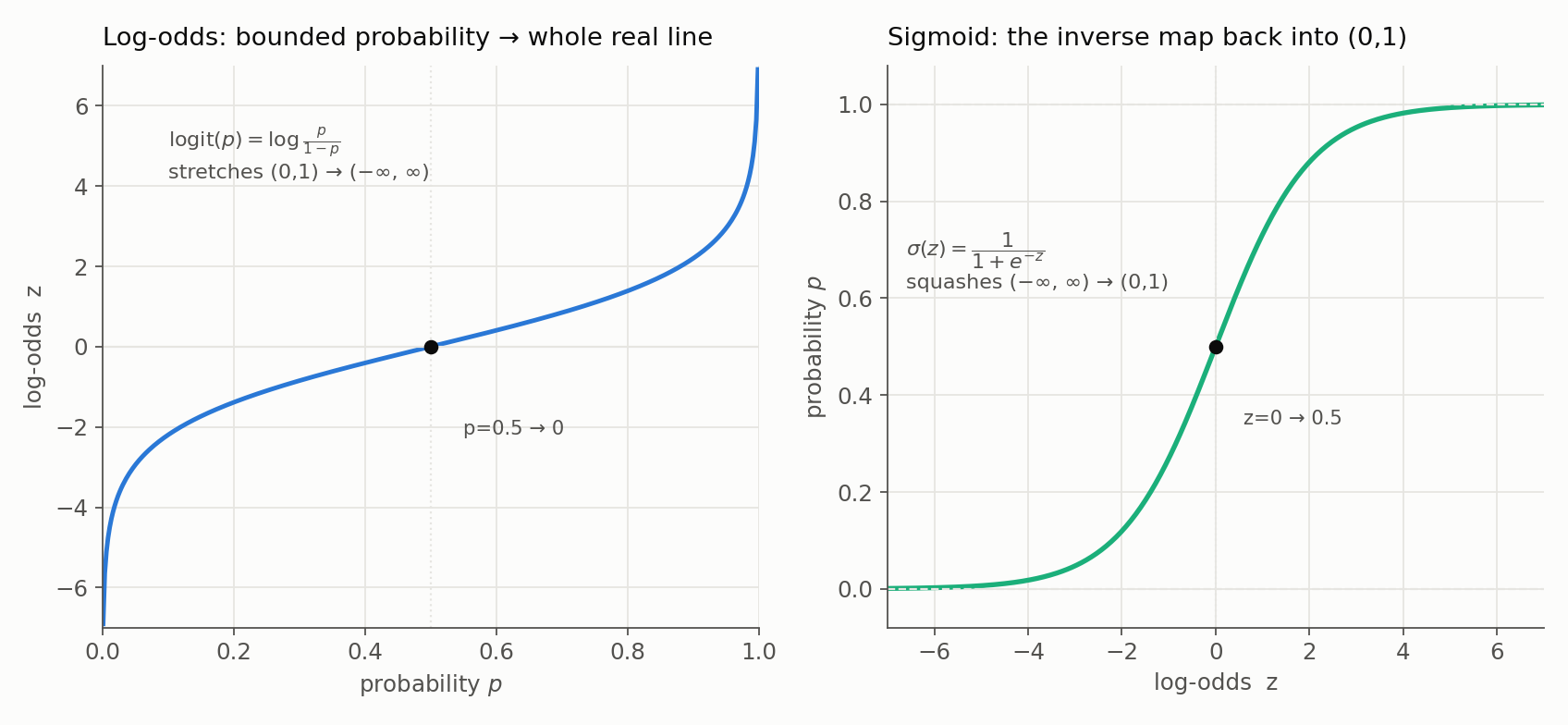
  1. Odds: First, we calculate the odds of winning ($\frac{P}{1-P}$). This maps our range from $[0, 1]$ to $[0, +\infty)$. This is better, but a linear equation can still output negative numbers.
  2. Log-Odds (The Logit): We take the natural logarithm of the odds. $\ln(\frac{P}{1-P})$. This maps the range to $(-\infty, +\infty)$.

Now the ranges match! We can safely say that the log-odds are linear with respect to practice hours:

\[\ln\left(\frac{P(\text{Win})}{1-P(\text{Win})}\right) = \beta_0 + \beta_1(\text{hours_practiced})\]

This link function allows the linear math to coexist with the bounded nature of probability.

2. The loss function used and the rationale behind it

We use the Log Loss (Binary Cross-Entropy) function, not Mean Squared Error (MSE).

\[J(\beta) = -\frac{1}{m} \sum_{i=1}^{m} [y_i \log(\hat{p}_i) + (1-y_i) \log(1-\hat{p}_i)]\]

There are two main reasons for this:

A. Extreme Penalties for “Confident & Wrong” Predictions In basketball, if a team practices 100 hours and your model predicts a 99% chance of winning ($\hat{p} \approx 1$), but they actually lose ($y=0$), MSE would calculate the error as $(1 - 0)^2 = 1$. That is a very small penalty. Log Loss, however, takes the log of the error. $\log(1 - 0.99)$ is a massive number. Log loss effectively imposes an infinite penalty on being confident but wrong, forcing the model to learn much faster.

B. Convexity (The Shape of the Bowl) This is the mathematical dealbreaker.

  • If you use MSE with the non-linear sigmoid function, the resulting cost surface becomes “wavy” (non-convex) with many hills and valleys (local minima). Gradient descent would likely get stuck in a valley that isn’t the true bottom.
  • Log Loss guarantees a convex shape (like a perfect bowl). This ensures that no matter where we start our optimization, gradient descent will always slide down to the single, global minimum - the best possible parameters for your model.

3. Why we apply MLE and why no closed-form solution is possible

Why MLE? Maximum Likelihood Estimation (MLE) is the statistical principle we use to build the loss function. It asks: “What specific values for $\beta_0$ and $\beta_1$ would make the observed history of basketball wins and losses most probable?” Minimizing the Log Loss is mathematically identical to maximizing the Likelihood.

Why no closed-form solution? In standard Linear Regression, we can set the derivative of the error to zero and solve it using basic algebra (the Normal Equation) to find the perfect $\beta$ values instantly.

In Logistic Regression, we cannot do this. When we calculate the gradient (derivative) of the cost function and set it to zero to find the minimum, we end up with an equation where the parameters $\beta$ are trapped inside the non-linear sigmoid exponent ($e^{-\beta x}$).

This results in a transcendental equation, meaning there is no algebraic way to isolate $\beta$ on one side of the equals sign. Because we cannot solve for $\beta$ directly (no closed-form), we must use iterative optimization algorithms like Gradient Descent to inch our way closer and closer to the solution step-by-step.

4. Understanding the Loss function with an example

Let’s assume y1=1, y2=0, y3=1 are the only 3 datapoints, how would the loss function look like?

Recall that the general Log Loss formula for a single sample is: \(\text{Loss}_i = -[y_i \log(\hat{p}_i) + (1-y_i) \log(1-\hat{p}_i)]\)

This formula acts like a “switch.” Since $y$ can only be 0 or 1, one of the two terms inside the brackets always becomes zero and disappears.

Here is how the loss function looks for your specific dataset where $m=3$:

Step-by-Step Breakdown

1. Sample 1 ($y_1 = 1$)

  • We plug $y_1=1$ into the formula: \(1 \cdot \log(\hat{p}_1) + (1-1) \cdot \log(1-\hat{p}_1)\)
  • The second part becomes $0 \cdot \dots$ and vanishes.
  • Result: $\log(\hat{p}_1)$

2. Sample 2 ($y_2 = 0$)

  • We plug $y_2=0$ into the formula: \(0 \cdot \log(\hat{p}_2) + (1-0) \cdot \log(1-\hat{p}_2)\)
  • The first part becomes $0 \cdot \dots$ and vanishes.
  • Result: $\log(1-\hat{p}_2)$

3. Sample 3 ($y_3 = 1$)

  • We plug $y_3=1$ into the formula: \(1 \cdot \log(\hat{p}_3) + (1-1) \cdot \log(1-\hat{p}_3)\)
  • The second part vanishes again.
  • Result: $\log(\hat{p}_3)$

The Final Combined Loss Function

To get the total cost function $J(\beta)$, we sum these individual results, multiply by -1, and average them (divide by 3).

\[J(\beta) = -\frac{1}{3} \left[ \underbrace{\log(\hat{p}_1)}_{\text{Sample 1}} + \underbrace{\log(1 - \hat{p}_2)}_{\text{Sample 2}} + \underbrace{\log(\hat{p}_3)}_{\text{Sample 3}} \right]\]

Interpretation

Notice what the math is telling the model to do to minimize the loss:

  • For Sample 1 & 3: Maximize $\hat{p}$ (push the probability of winning close to 1).
  • For Sample 2: Maximize $1 - \hat{p}$ (which means pushing $\hat{p}$ close to 0, or “not winning”).

Let’s visualize Gradient Descent as a hiker trying to walk down a hill blindfolded to find the lowest point (minimum loss).

5. Connecting the dots with gradient descent

Here is exactly how the algorithm calculates the “steps” to take for your specific samples ($y_1=1, y_2=0, y_3=1$).

a. The Gradient Formulas

First, we need the “slope” of the loss function. Even though the Loss Function involves logs, the derivative (gradient) simplifies into a beautiful, intuitive formula:

For $\beta_0$ (Intercept): \(\frac{\partial J}{\partial \beta_0} = \frac{1}{3} \sum_{i=1}^{3} (\hat{p}_i - y_i)\) (It is simply the average prediction error).

For $\beta_1$ (Slope for Hours Practiced): \(\frac{\partial J}{\partial \beta_1} = \frac{1}{3} \sum_{i=1}^{3} (\hat{p}_i - y_i) \cdot x_i\) (It is the average prediction error weighted by the input $x$).

b. The “Tug of War” (Calculating the Nudges)

Let’s imagine the algorithm is currently at iteration 1. It has random values for $\beta$, and it makes predictions. Let’s see how each sample tries to “push” or “pull” the coefficients.

Sample 1 ($y_1=1$, Practiced $x_1$ hours)

  • Goal: Wants $\hat{p}_1$ to be 1.0.
  • Current Prediction: Let’s say $\hat{p}_1 = 0.6$.
  • Error ($\hat{p}_1 - y_1$): $0.6 - 1.0 = \mathbf{-0.4}$.
  • The Push: The error is negative. This tells the gradient: “The prediction was too low! We need to increase $\beta$ to push the probability up.”

Sample 2 ($y_2=0$, Practiced $x_2$ hours)

  • Goal: Wants $\hat{p}_2$ to be 0.0.
  • Current Prediction: Let’s say $\hat{p}_2 = 0.8$.
  • Error ($\hat{p}_2 - y_2$): $0.8 - 0.0 = \mathbf{+0.8}$.
  • The Push: The error is positive. This tells the gradient: “The prediction was too high! We need to decrease $\beta$ to push the probability down.”

Sample 3 ($y_3=1$, Practiced $x_3$ hours)

  • Goal: Wants $\hat{p}_3$ to be 1.0.
  • Current Prediction: Let’s say $\hat{p}_3 = 0.4$.
  • Error ($\hat{p}_3 - y_3$): $0.4 - 1.0 = \mathbf{-0.6}$.
  • The Push: The error is negative. Like Sample 1, this tells the gradient to increase $\beta$.

c. The Update Step (Optimizing $\beta_0$ and $\beta_1$)

Gradient Descent aggregates these “votes” and updates the parameters using the learning rate ($\alpha$).

The Update Rule is: $\beta_{new} = \beta_{old} - \alpha \times \text{Gradient}$

d. Optimizing $\beta_0$ (The Baseline)

The gradient for $\beta_0$ is just the average of the errors: \(\text{Gradient}_{\beta_0} = \frac{-0.4 + 0.8 - 0.6}{3} = \frac{-0.2}{3} = -0.066\)

  • The average error is negative.
  • Update: $\beta_0 - \alpha(-0.066) \rightarrow \beta_0 + \text{small amount}$.
  • Result: The intercept increases. The model realizes it was generally underestimating the win rate, so it shifts the whole curve up.

e. Optimizing $\beta_1$ (The Impact of Practice)

The gradient for $\beta_1$ depends on the errors multiplied by the hours practiced ($x$). This is crucial.

  • Let’s say Sample 2 (the loss) practiced a LOT ($x_2 = 100$).
  • Let’s say Sample 1 and 3 (the wins) practiced very little ($x_1=10, x_3=10$).

\(\text{Gradient}_{\beta_1} = \frac{(-0.4 \cdot 10) + (0.8 \cdot 100) + (-0.6 \cdot 10)}{3}\) \(\text{Gradient}_{\beta_1} = \frac{-4 + 80 - 6}{3} = \frac{70}{3} = +23.3\)

  • Even though there were 2 wins and 1 loss, the “Loss” sample had a huge $x$ value. It dominates the gradient.
  • The gradient is positive.
  • Update: $\beta_1 - \alpha(+23.3) \rightarrow \beta_1 - \text{large amount}$.
  • Result: The coefficient $\beta_1$ decreases.

Why? Because the model saw someone who practiced 100 hours and still lost. This is strong evidence that “practice hours” might not be as positively correlated with winning as we thought, so it reduces the weight ($\beta_1$) of that feature.

Summary

Gradient descent acts as a mediator:

  1. It calculates how “wrong” the model was for each game.
  2. It allows games with larger feature values ($x$) to have a louder voice in changing the slope ($\beta_1$).
  3. It sums up all these complaints (gradients).
  4. It takes a small step in the opposite direction to satisfy the majority of the data points.

6. Show the derivation of the gradient formulation for the intercept.

Here is the step-by-step derivation. It is a beautiful piece of calculus because several complex terms cancel each other out perfectly to yield a simple final result.

To find the gradient $\frac{\partial J}{\partial \beta_0}$, we must use the Chain Rule.

The Setup

We have three linked components:

  1. The Cost Function ($J$): The average of the individual losses ($L$). \(J = \frac{1}{m} \sum_{i=1}^m L_i\)
  2. The Loss Function ($L$) for a single sample: \(L = -[y \ln(\hat{p}) + (1-y) \ln(1-\hat{p})]\)
  3. The Prediction ($\hat{p}$): The sigmoid of the linear input ($z$). \(\hat{p} = \sigma(z) = \frac{1}{1+e^{-z}}\)
  4. The Linear Input ($z$): \(z = \beta_0 + \beta_1 x_1\)

The Chain Rule

To find how the Cost ($L$) changes when $\beta_0$ changes, we follow the chain: \(\beta_0 \rightarrow z \rightarrow \hat{p} \rightarrow L\)

Mathematically: \(\frac{\partial L}{\partial \beta_0} = \frac{\partial L}{\partial \hat{p}} \times \frac{\partial \hat{p}}{\partial z} \times \frac{\partial z}{\partial \beta_0}\)

Let’s calculate these three partial derivatives one by one.

Step 1: Derivative of Loss w.r.t. Prediction ($\frac{\partial L}{\partial \hat{p}}$)

\[L = -y \ln(\hat{p}) - (1-y) \ln(1-\hat{p})\]

Recall that the derivative of $\ln(x)$ is $\frac{1}{x}$.

\(\frac{\partial L}{\partial \hat{p}} = -y \left(\frac{1}{\hat{p}}\right) - (1-y) \left(\frac{1}{1-\hat{p}} \cdot (-1)\right)\) (Note: The -1 at the end comes from the chain rule derivative of $(1-\hat{p})$)

\[\frac{\partial L}{\partial \hat{p}} = -\frac{y}{\hat{p}} + \frac{1-y}{1-\hat{p}}\]

Now, let’s combine these into a single fraction: \(\frac{\partial L}{\partial \hat{p}} = \frac{-y(1-\hat{p}) + \hat{p}(1-y)}{\hat{p}(1-\hat{p})}\) \(\frac{\partial L}{\partial \hat{p}} = \frac{-y + y\hat{p} + \hat{p} - y\hat{p}}{\hat{p}(1-\hat{p})}\) \(\frac{\partial L}{\partial \hat{p}} = \frac{\hat{p} - y}{\hat{p}(1-\hat{p})}\)

Step 2: Derivative of Prediction w.r.t. z ($\frac{\partial \hat{p}}{\partial z}$)

This is the derivative of the sigmoid function $\sigma(z)$. A unique property of the sigmoid function is that its derivative can be expressed using the function itself.

\(\sigma'(z) = \sigma(z)(1 - \sigma(z))\) \(\frac{\partial \hat{p}}{\partial z} = \hat{p}(1 - \hat{p})\)

Step 3: Derivative of z w.r.t. $\beta_0$ ($\frac{\partial z}{\partial \beta_0}$)

Since $z = \beta_0 + \beta_1 x$:

\[\frac{\partial z}{\partial \beta_0} = 1\]

(Because $\beta_0$ is just an intercept constant).

Step 4: Putting it all together (The “Magic” Cancellation)

Now we multiply the three parts together:

\[\frac{\partial L}{\partial \beta_0} = \left[ \frac{\hat{p} - y}{\hat{p}(1-\hat{p})} \right] \times \left[ \hat{p}(1-\hat{p}) \right] \times [1]\]

Notice that the denominator from Step 1 perfectly cancels out the result from Step 2!

\[\frac{\partial L}{\partial \beta_0} = (\hat{p} - y)\]

Final Step: Summing over all samples

The calculation above was for a single sample. The total cost function $J$ is the average over all $m$ samples. So, we sum this result for all samples and divide by $m$.

\[\frac{\partial J}{\partial \beta_0} = \frac{1}{m} \sum_{i=1}^{m} (\hat{p}_i - y_i)\]

And there is your formula: the gradient of the intercept is simply the average error of the predictions.


2. How can we interpret the coefficients in Logistic Regression?

Interpreting the coefficients in logistic regression isn’t as straightforward as in linear regression (where they represent a simple slope), but it’s incredibly insightful once you understand the concept of odds.

The key is to realize that logistic regression models the log-odds of an event happening. Therefore, the coefficients must be interpreted in relation to this scale.

The Foundation: From Log-Odds to Odds Ratios

The logistic regression equation is:

\[\ln\left(\frac{P}{1-P}\right) = \beta_0 + \beta_1 X_1 + \beta_2 X_2 + \dots + \beta_k X_k\]

Let’s break this down:

  • P: The probability of the event of interest occurring (e.g., the team winning).
  • P / (1-P): This is the odds of the event. It’s the ratio of the probability of the event happening to the probability of it not happening.
  • ln(P / (1-P)): This is the log-odds or logit. The logistic regression model predicts this value.
  • β₁…βk: These are the coefficients for each predictor variable. They represent the change in the log-odds for a one-unit change in the predictor.

Because “log-odds” are not intuitive for most people, we exponentiate the coefficient to get an Odds Ratio (OR).

\[OR = e^\beta\]

The Odds Ratio is the most common and intuitive way to interpret the coefficients. It tells you how the odds of the outcome event change for a one-unit increase in the predictor variable, holding all other variables constant.

Derivation of the Odds Ratio (OR)

Remember the fundamental equation: \(\log(\text{odds}) = \beta_0 + \beta_1 X_1 + \beta_2 X_2 + ...\)

Let’s focus on interpreting the coefficient $\beta_1$ for the predictor $X_1$.

Scenario 1: The odds at some value of $X_1$

Let’s calculate the predicted odds for a specific observation where $X_1$ has some value, and all other predictors ($X_2$, $X_3$, etc.) are held at constant values.

\[\text{odds}_1 = e^{(\beta_0 + \beta_1 X_1 + \beta_2 X_2 + ...)}\]

Scenario 2: The odds when $X_1$ increases by one unit

Now, let’s see what happens to the odds when we increase only $X_1$ by one unit (from $X_1$ to $X_1 + 1$), keeping everything else the same.

\[\text{odds}_2 = e^{(\beta_0 + \beta_1 (X_1 + 1) + \beta_2 X_2 + ...)}\]

Calculating the Odds Ratio (OR)

The odds ratio is the ratio of the odds in Scenario 2 to the odds in Scenario 1. It tells us how much the odds were multiplied by when we increased $X_1$ by one.

\[\text{OR} = \text{odds}_2 / \text{odds}_1\]

Now let’s substitute the equations. Look at what happens inside that exponent. Almost every term cancels out!

  • $\beta_0 - \beta_0 = 0$
  • $\beta_1 X_1 - \beta_1 X_1 = 0$
  • $\beta_2 X_2 - \beta_2 X_2 = 0$
  • …and so on for all other variables.

The only term that doesn’t cancel out is the single $\beta_1$ from the numerator.

So, the entire expression simplifies to:

\[\text{OR} = e^{\beta_1}\]

Conclusion

This is why $e^{\beta}$ is the odds ratio. It isolates the effect of a single predictor by showing the multiplicative change in the odds. The other terms all cancel out when you calculate the ratio of the odds, leaving you with just the exponentiated coefficient for the variable you’re interested in.

How to Interpret the Odds Ratio (OR)

Let’s look at the different scenarios for an Odds Ratio:

  • If OR > 1: For a one-unit increase in the predictor, the odds of the outcome occurring increase by a factor of the OR. It’s associated with a higher likelihood of the event.
  • If OR < 1: For a one-unit increase in the predictor, the odds of the outcome occurring decrease by a factor of the OR. It’s associated with a lower likelihood of the event.
  • If OR = 1: The predictor has no effect on the odds of the outcome.

Interpreting Different Types of Variables

The interpretation varies slightly depending on whether the predictor is continuous or categorical.

1. For a Continuous Variable

Let’s use the example: predicting a win based on no_of_hours_practiced.

Assume our logistic regression model gives us a coefficient $\beta_1 = 0.05$ for the no_of_hours_practiced variable.

  1. Direct Coefficient Interpretation (Log-Odds):
    • For each additional hour of practice, the log-odds of the team winning increases by 0.05, holding all other factors constant. (This is correct, but not very intuitive).
  2. Odds Ratio Interpretation (More Intuitive):
    • First, calculate the Odds Ratio: $OR = e^{0.05} \approx 1.051$
    • Interpretation: For each additional hour of practice, the odds of the team winning increase by a factor of 1.051, or about 5.1%.

2. For a Categorical Variable

Now let’s add a categorical variable to our model, for example, match_location with two categories: “Home” and “Away”.

To include this in the model, we use dummy coding. We create a variable, let’s call it is_home_match, where:

  • is_home_match = 1 if the match is at home.
  • is_home_match = 0 if the match is away (this is our “reference” or “baseline” category).

Suppose the model gives a coefficient $\beta_2 = 0.693$ for is_home_match.

  1. Direct Coefficient Interpretation (Log-Odds):
    • The log-odds of winning for a home match are 0.693 higher than for an away match, holding practice hours constant.
  2. Odds Ratio Interpretation (More Intuitive):
    • Calculate the Odds Ratio: $OR = e^{0.693} \approx 2.0$
    • Interpretation: The odds of winning when playing at home are twice as high as the odds of winning when playing away, assuming the same number of practice hours.

A Practical Example Summary

Imagine your final model is:

\[\ln(\text{odds_of_winning}) = -3.0 + 0.05 \times (\text{hours_practiced}) + 0.693 \times (\text{is_home_match})\]

And the corresponding Odds Ratios are:

  • For hours_practiced: $e^{0.05} \approx 1.051$
  • For is_home_match: $e^{0.693} \approx 2.0$

You would report this as:

“Controlling for match location, each additional hour of practice increases the odds of winning by 5.1%. Furthermore, controlling for practice hours, the odds of winning a home match are double the odds of winning an away match.”

This interpretation is powerful because it allows you to quantify the impact of each predictor on the likelihood of the outcome in a way that is both statistically sound and easy to understand.


3. To interpret the coeffients in this way, do we need to scale the features before training the model?

The short answer is: No, you do not need to scale features to interpret the coefficients as odds ratios. However, whether you should scale them depends on your primary goal: direct interpretation vs. model performance and feature comparison.

Here’s the detailed breakdown of the trade-off:

Case 1: You DO NOT Scale Your Features

This is often preferred when your main goal is straightforward, intuitive interpretation.

  • How it works: The interpretation of $e^\beta$ remains the same: “A one-unit increase in the predictor X is associated with a multiplicative change of $e^\beta$ in the odds of the outcome.”
  • The “Unit” is Natural: The key is that the “one-unit” is in the original, natural scale of your data.
    • If your predictor is age in years, a one-unit change is one year.
    • If your predictor is price in dollars, a one-unit change is one dollar.
    • If your predictor is distance in kilometers, a one-unit change is one kilometer.
  • Advantage: This is the easiest interpretation to explain to a non-technical audience. “For every additional year of age, the odds of purchasing the product increase by 5%” is much clearer than talking about standard deviations.

  • Disadvantage:
    1. Model Convergence: If your features are on wildly different scales (e.g., age from 20-80 and income from 20,000-200,000), the gradient descent algorithm used to train the model can struggle and may take longer to converge.
    2. Cannot Compare Coefficients: You cannot compare the magnitude of the coefficients to infer feature importance. A coefficient of 0.05 for income is not necessarily less important than a coefficient of 1.2 for number_of_children, because a “one-unit” change means something completely different for each.

Case 2: You DO Scale Your Features

This is the standard practice when your main goal is model performance, stability, and comparing the relative importance of features. The most common method is Standardization (scaling to have a mean of 0 and a standard deviation of 1).

  • How it works: Again, the interpretation of $e^\beta$ is for a “one-unit” change in the predictor.
  • The “Unit” is Standard Deviations: But now, because the feature has been standardized, a “one-unit” change means a one standard deviation increase from the mean.

  • Advantage:
    1. Better Model Performance: Scaling helps the optimization algorithm converge quickly and reliably. It’s considered a best practice for most machine learning models.
    2. Required for Regularization: If you use regularization (like Ridge or Lasso), scaling is essential to ensure that the penalty is applied fairly to all coefficients.
    3. Can Compare Coefficients: Because all features are on the same scale, you can now compare the magnitude of their coefficients. A larger absolute value of $\beta$ (and thus an odds ratio further from 1) suggests that the feature has a stronger impact on the log-odds of the outcome.
  • Disadvantage: The interpretation is less direct. You have to phrase it as: “For every one standard deviation increase in age, the odds of the outcome increase by a factor of $e^\beta$.” You then have to follow up by explaining what one standard deviation of age is in your data (e.g., “which is equivalent to 12.5 years”).

Summary and Recommendation

GoalTo Scale or Not?Why?
Easy, Direct InterpretationDon’t Scale (or train a separate model without scaling for interpretation)The “one-unit change” is in natural units (years, dollars, etc.) which is easy to explain.
Model Performance & StabilityScaleHelps the optimization algorithm converge. It is a machine learning best practice.
Comparing Feature ImportanceScaleAllows you to compare coefficient magnitudes because all features are on the same scale.
Using Regularization (L1/L2)Scale (Mandatory)Ensures the regularization penalty is applied fairly across all features.

Best Practice Workflow: For a robust analysis, many data scientists do both:

  1. Scale the features to build the best, most stable, and well-performing final model.
  2. Use this scaled model for prediction and for comparing the relative importance of variables.
  3. If a simple, direct interpretation is required for a report or presentation, you can either:
    • Build a separate, unscaled model just for the purpose of interpreting the coefficients in their natural units.
    • Translate the “one standard deviation” unit from your scaled model back into its original units for your explanation.

4. Is Logistic Regression a linear model?

Yes, logistic regression is a linear model, but the phrase “linear model” refers to something very specific. Once you understand what is linear and where, the confusion disappears.

Let’s break it down cleanly.

Short Answer

Yes, logistic regression is a linear model because:

It is linear in the parameters (the weights), not in the output.

This is the key idea.

Long Answer: What “Linear” Actually Means

In ML/statistics, a linear model is one where the prediction is a linear combination of the input features:

\[z = w_1 x_1 + w_2 x_2 + \cdots + w_d x_d + b\]

This part is 100% linear.

Logistic regression takes that linear score (z) and passes it through a nonlinear link function (the sigmoid):

\[\hat{y} = \sigma(z) = \frac{1}{1 + e^{-z}}\]

The sigmoid squashes the result into a probability between 0 and 1, that’s the only nonlinearity.

So:

  • Linear in the weights → yes
  • Linear in the inputs before the sigmoid → yes
  • Final output linear? → no, because of sigmoid

And that’s okay, the model is still classified as a generalized linear model (GLM).

What Is NOT Linear About It

  • The decision boundary is linear only in the original feature space.

    • Example: $( \text{w}_1 \text{x}_1 + \text{w}_2 \text{x}_2 + \text{b} = 0 )$
  • But the probabilities are nonlinear due to the sigmoid.

That’s why logistic regression is both:

  • linear (in parameters / decision boundary)
  • nonlinear (in output probabilities)

5. If we have more than two classes in our classification problem, can Logistic Regression still be used there?

Yes, absolutely!

While the classic form of logistic regression is designed for binary classification (two classes), it can be cleverly extended to handle multiclass classification problems where you have three or more classes.

There are two primary strategies for doing this:

1. One-vs-Rest (OvR) or One-vs-All (OvA)

This is the most intuitive and common approach. It breaks down the multiclass problem into multiple binary classification problems.

How it works: Imagine you have a problem with three classes: Cat, Dog, and Bird.

Instead of trying to solve one complex problem, you train three separate binary logistic regression models:

  1. Model 1 (Cat vs. Not Cat): This model is trained to distinguish Cat (as the positive class) from Dog and Bird combined (as the negative class).
  2. Model 2 (Dog vs. Not Dog): This model is trained to distinguish Dog (positive class) from Cat and Bird (negative class).
  3. Model 3 (Bird vs. Not Bird): This model is trained to distinguish Bird (positive class) from Cat and Dog (negative class).

To make a new prediction: When you get a new image, you run it through all three models. Each model outputs a probability.

  • Model 1 might say: “70% probability this is a Cat.”
  • Model 2 might say: “15% probability this is a Dog.”
  • Model 3 might say: “10% probability this is a Bird.”

You simply choose the class with the highest probability. In this case, you would classify the image as a Cat.

2. Multinomial Logistic Regression (Softmax Regression)

This is a more direct and statistically sophisticated approach. Instead of training multiple independent binary models, you train a single, unified model that is a direct generalization of logistic regression.

How it works: This model uses the Softmax function (which is a generalization of the sigmoid function) as its final step.

  • The model calculates a score for each class.
  • The Softmax function takes these scores and converts them into a probability distribution, ensuring that the probabilities for all classes add up to 1.

For the same new image, a Multinomial/Softmax model would directly output something like:

  • Probability of Cat: 0.75
  • Probability of Dog: 0.18
  • Probability of Bird: 0.07
  • (Total = 1.0)

You again pick the class with the highest probability, which is Cat.

Which one is used in practice?

Most modern machine learning libraries, including scikit-learn, will automatically handle this for you. If you pass a target variable with more than two classes to sklearn.linear_model.LogisticRegression, it will, by default, use the One-vs-Rest (OvR) strategy. However, you can explicitly tell it to use Multinomial Logistic Regression by setting the multi_class parameter:

  • LogisticRegression(multi_class='ovr') (the default)
  • LogisticRegression(multi_class='multinomial')

In general, the multinomial (Softmax) approach is often preferred as it trains a single, well-calibrated model, but OvR is also very effective and easier to understand.


6. Elaborate how the softmax based logistic regression works with an example. Use appropriate mathematical formulation as required.

Let’s Assume we’re trying to use multinomial logistic regression to predict whether a person would like one of these three flavours of ice creams: vanilla, chocolate or strawberry. Let’s also assume our independent variables are age, and gender. Here is how the log-odds equations for our ice cream preference model would be structured in multinomial logistic regression.

A key concept in multinomial logistic regression is the use of a reference category. The model calculates the log-odds of an outcome for each category relative to this reference category.

Let’s choose Vanilla as our reference category. This is a common choice, but any of the three could be selected.

Variable Setup

First, we need to define our variables:

  • Age: This is a continuous variable, let’s call it X₁.
  • Gender: This is a categorical variable. To use it in the model, we need to create a dummy variable. Let’s create X₂ where:
    • X₂ = 1 if the person is Female
    • X₂ = 0 if the person is Male (Male will be the baseline for gender)

The Log-Odds Equations

Since we have 3 classes (Vanilla, Chocolate, Strawberry) and Vanilla is our reference, the model will produce 3 - 1 = 2 log-odds equations.

Each equation will have its own unique set of coefficients (an intercept $\beta_0$, a coefficient for age $\beta_1$, and a coefficient for gender $\beta_2$).

Equation 1: Log-Odds of Preferring Chocolate vs. Vanilla

This equation models the logarithm of the odds that a person prefers Chocolate over Vanilla.

\[\ln\left(\frac{P(\text{Chocolate})}{P(\text{Vanilla})}\right) = \beta_{0, \text{choc}} + \beta_{1, \text{choc}} \cdot (\text{Age}) + \beta_{2, \text{choc}} \cdot (\text{Gender})\]
  • $\beta_{0, \text{choc}}$ (Intercept): The baseline log-odds of preferring Chocolate over Vanilla for a male (Gender=0) of age 0.
  • $\beta_{1, \text{choc}}$ (Age Coefficient): The change in the log-odds of preferring Chocolate over Vanilla for each one-year increase in age, holding gender constant.
  • $\beta_{2, \text{choc}}$ (Gender Coefficient): The change in the log-odds of preferring Chocolate over Vanilla if the person is female, compared to being male, holding age constant.

Equation 2: Log-Odds of Preferring Strawberry vs. Vanilla

Similarly, this equation models the logarithm of the odds that a person prefers Strawberry over Vanilla.

\[\ln\left(\frac{P(\text{Strawberry})}{P(\text{Vanilla})}\right) = \beta_{0, \text{straw}} + \beta_{1, \text{straw}} \cdot (\text{Age}) + \beta_{2, \text{straw}} \cdot (\text{Gender})\]
  • $\beta_{0, \text{straw}}$ (Intercept): The baseline log-odds of preferring Strawberry over Vanilla for a male (Gender=0) of age 0.
  • $\beta_{1, \text{straw}}$ (Age Coefficient): The change in the log-odds of preferring Strawberry over Vanilla for each one-year increase in age, holding gender constant.
  • $\beta_{2, \text{straw}}$ (Gender Coefficient): The change in the log-odds of preferring Strawberry over Vanilla if the person is female, compared to being male, holding age constant.

Why is there no equation for Vanilla?

There is no equation for the reference category (Vanilla) because the log-odds of preferring Vanilla over Vanilla would be ln(P(Vanilla)/P(Vanilla)) = ln(1) = 0. All effects are measured relative to this baseline. The model uses these two equations along with the constraint that all probabilities must sum to 1 (P(Vanilla) + P(Chocolate) + P(Strawberry) = 1) to calculate the individual probabilities for each of the three flavors.

The Setup

For simplicity, let’s represent the entire linear combination of coefficients and variables with $Z$:

  • $\text{Z_choc} = \beta_{0, \text{choc}} + \beta_{1, \text{choc}} \cdot (\text{Age}) + \beta_{2, \text{choc}} \cdot (\text{Gender})$
  • $\text{Z_straw} = \beta_{0, \text{straw}} + \beta_{1, \text{straw}} \cdot (\text{Age}) + \beta_{2, \text{straw}} \cdot (\text{Gender})$

We have two core equations and the fundamental constraint that all probabilities must sum to 1:

  1. \[\ln\left(\frac{P(\text{Chocolate})}{P(\text{Vanilla})}\right) = \text{Z_choc}\]
  2. \[\ln\left(\frac{P(\text{Strawberry})}{P(\text{Vanilla})}\right) = \text{Z_straw}\]
  3. \[P(\text{Vanilla}) + P(\text{Chocolate}) + P(\text{Strawberry}) = 1\]

Our goal is to isolate P(Chocolate) from these three equations.

Step-by-Step Derivation

Step 1: Exponentiate the log-odds equations to solve for the odds.

We apply the exponential function e to both sides of equations 1 and 2 to remove the natural log ln.

  • From equation 1: $P(\text{C})/P(\text{V}) = e^{\text{Z_choc}}$
  • From equation 2: $P(\text{S})/P(\text{V}) = e^{\text{Z_straw}}$

Step 2: Express P(Chocolate) and P(Strawberry) in terms of P(Vanilla).

From the results in Step 1, we can rearrange the terms:

  • $P(\text{C}) = P(\text{V}) \times e^{\text{Z_choc}}$ (Let’s call this Equation 4)
  • $P(\text{S}) = P(\text{V}) \times e^{\text{Z_straw}}$ (Let’s call this Equation 5)

This shows that the probabilities of the other categories are proportional to the probability of the reference category, scaled by their respective exponentiated scores.

Step 3: Substitute these into the probability constraint equation.

Now we take our main constraint (Equation 3) and replace P(Chocolate) and P(Strawberry) with what we found in Step 2.

\[P(\text{V}) + (P(\text{V}) \times e^{\text{Z_choc}}) + (P(\text{V}) \times e^{\text{Z_straw}}) = 1\]

Step 4: Solve for the probability of the reference category, P(Vanilla).

We can factor out P(Vanilla) from the left side of the equation:

\[P(\text{V}) \times (1 + e^{\text{Z_choc}} + e^{\text{Z_straw}}) = 1\]

Now, divide both sides to isolate P(Vanilla):

\[P(\text{V}) = 1 / (1 + e^{\text{Z_choc}} + e^{\text{Z_straw}})\]

Step 5: Derive the final probability for P(Chocolate).

We’re almost there. We go back to Equation 4 from Step 2: $P(\text{C}) = P(\text{V}) \times e^{\text{Z_choc}}$ and substitute the expression for P(Vanilla) that we just found in Step 4:

Simplifying this gives our final formula:

\[P(\text{Chocolate}) = \frac{e^{Z_{\text{choc}}}}{1 + e^{Z_{\text{choc}}} + e^{Z_{\text{straw}}}}\]

Connection to the Sigmoid Function and Final Softmax Form

This looks very similar to the Softmax formula we discussed earlier. To make the connection perfect, remember that the “score” for our reference category, Vanilla, is implicitly zero.

The log-odds of preferring Vanilla over Vanilla is $\ln(\text{P(V)}/\text{P(V)}) = \ln(1) = 0$. So, we can say $\text{Z_van} = 0$.

This means that $e^{\text{Z_van}} = e^0 = 1$.

If we substitute $e^{\text{Z_van}}$ for the 1 in our denominator, we get the generalized Softmax function:

\[P(\text{Chocolate}) = \frac{e^{Z_{\text{choc}}}}{e^{Z_{\text{van}}} + e^{Z_{\text{choc}}} + e^{Z_{\text{straw}}}}\]

This demonstrates that the probability for any given class is the exponentiated score for that class divided by the sum of the exponentiated scores for all possible classes, including the reference category. This is exactly how the sigmoid function is a special case of the softmax function when there are only two classes.


7. What is the connection between binary Logistic Regression and a Neural Network?

The connection is very direct:

A binary logistic regression model is mathematically equivalent to a neural network with a single neuron.

You can think of logistic regression as the fundamental building block of a neural network. Let’s break down the parallels component by component.

Visualizing the Connection

Imagine a neural network with no hidden layers, just an input layer and a single output neuron. This is exactly what logistic regression is.

Side-by-Side Comparison

Let’s compare the steps and terminology for both:

Component / StepBinary Logistic RegressionSingle-Neuron Neural Network
InputsA vector of input features X = (x₁, x₂, ...)The input layer, which takes features X = (x₁, x₂, ...)
Processing Step 1: Linear CombinationCalculates a linear score: <br> z = β₀ + β₁x₁ + β₂x₂ + ...The neuron calculates a weighted sum of its inputs plus a bias: <br> z = (w₁x₁ + w₂x₂ + ...) + b
ParametersCoefficients β₁, β₂, … and an intercept β₀.Weights w₁, w₂, … and a bias b. (Coefficients are equivalent to weights, and the intercept is the bias).
Processing Step 2: Non-Linear FunctionApplies the Sigmoid function to the score z to get a probability: <br> P(y=1) = σ(z)Applies an Activation Function to the weighted sum z. For binary classification, the classic choice is the Sigmoid function.
OutputA single value between 0 and 1, representing the probability of the positive class.A single output value from the neuron, which is interpreted as the probability of the positive class.
Loss FunctionBinary Cross-Entropy (Log Loss)Binary Cross-Entropy (the standard loss function for binary classification).
Training MethodGradient Descent (or similar optimizers) to find the β values that minimize the loss.Gradient Descent (and backpropagation) to find the w and b values that minimize the loss.

The Key Takeaway

As you can see, the structure, mathematical operations, and training process are identical. A logistic regression classifier is a neural network in its simplest possible form.

The power and complexity of “deep learning” come from what happens when you start adding more to this simple structure:

  1. Adding More Neurons: If you add more neurons in the output layer, you can perform multiclass classification (like the Softmax Regression we discussed).
  2. Adding Hidden Layers: When you stack layers of neurons between the input and output, you create a “deep” neural network. These hidden layers allow the network to learn progressively more complex and abstract patterns from the data, which is something a simple logistic regression model cannot do.

So, understanding logistic regression is a fantastic starting point for understanding neural networks, because a neural network is essentially a collection of these logistic regression-like units, stacked in clever ways to solve much more difficult problems.


8. What should we do if the training data for a Logistic Regression model are imbalanced?

That’s a critical and very common problem in real-world machine learning. If your training data is imbalanced (e.g., 90% “yes” and 10% “no”), a standard logistic regression model will perform poorly, and you need to take specific actions to handle it.

Here’s why it’s a problem and what you should do about it.

Why is an Imbalanced Dataset a Problem?

  1. The Accuracy Trap: A “lazy” model can achieve 90% accuracy by simply always predicting “yes” for every single sample. While its accuracy score looks great, the model is completely useless because it has zero ability to identify the “no” cases, which are often the ones you’re most interested in.
  2. Model Bias: The model’s loss function is dominated by the majority class (“yes”). To minimize its overall error, the model learns to be extremely biased towards predicting “yes”. It doesn’t get penalized enough for misclassifying the rare “no” cases, so it never learns the patterns that define them.

Here are the best strategies to address this issue, ranked from what you should try first to more advanced techniques.

Strategy 1: Use Appropriate Evaluation Metrics (Absolutely Essential)

This is the most important step. Do not use “accuracy” as your primary evaluation metric. It will be misleading. Instead, you must use metrics that give insight into how well the model is performing on the rare, minority class (“no”).

  • Confusion Matrix: Always start by looking at this. It will show you exactly where the model is failing (e.g., a high number of False Negatives, where it predicts “yes” but the answer was “no”).
  • Precision and Recall:
    • Recall (Sensitivity): Of all the actual “no” cases, how many did the model correctly identify? This is crucial for finding the minority class.
    • Precision: Of all the times the model predicted “no”, how many were actually correct? This measures the cost of a false alarm.
  • F1-Score: The harmonic mean of Precision and Recall. It provides a single score that balances the two, which is excellent for imbalanced problems.
  • ROC AUC Score: As we’ve discussed, this is a great metric because it evaluates the model across all thresholds. It measures the model’s ability to distinguish between “yes” and “no” cases.
  • Precision-Recall (PR) AUC: This is often considered even better than ROC AUC for highly imbalanced datasets because it focuses more on the performance of the minority class.

Strategy 2: Use Class Weighting (Easy and Effective)

This is usually the best first thing to try at the model level. You can tell the logistic regression algorithm to pay more attention to the minority class by giving it a higher “weight”.

How it works: You modify the loss function so that the penalty for misclassifying a “no” sample is much higher than for a “yes” sample. In your case, you would give the “no” class a weight of 9 and the “yes” class a weight of 1. This forces the model to work much harder to learn the patterns of the rare class.

In Python (scikit-learn): This is incredibly easy to implement. You just set one parameter.

1
2
3
4
5
6
7
8
9
10
from sklearn.linear_model import LogisticRegression

# The 'balanced' mode automatically adjusts weights inversely
# proportional to class frequencies.
model = LogisticRegression(class_weight='balanced')

# Or you can set it manually
# model = LogisticRegression(class_weight={0: 9.0, 1: 1.0}) # Assuming 'no' is 0, 'yes' is 1

model.fit(X_train, y_train)

Strategy 3: Resample Your Training Data

This approach involves modifying the training dataset to make it balanced before you feed it to the model.

  1. Undersampling the Majority Class:
    • What it is: Randomly remove samples from the majority class (“yes”) until it’s balanced with the minority class (“no”).
    • Pros: Can make training much faster on very large datasets.
    • Cons: You might throw away valuable information contained in the majority class samples you discard.
  2. Oversampling the Minority Class:
    • What it is: Randomly duplicate samples from the minority class (“no”) until it’s balanced.
    • Pros: Doesn’t lose any data.
    • Cons: Can lead to the model overfitting on the specific “no” samples it has seen, as it’s just seeing the same data again and again.
  3. Synthetic Data Generation (SMOTE):
    • What it is: SMOTE (Synthetic Minority Over-sampling Technique) is a smarter way to oversample. Instead of duplicating samples, it creates new, synthetic samples of the minority class. It does this by looking at a “no” sample, finding its nearest “no” neighbors, and creating a new point somewhere along the lines connecting them.
    • Pros: Often the most effective resampling technique. Creates a richer dataset for the minority class without simple duplication, reducing the risk of overfitting.
  1. Always start with Step 1: Immediately switch your evaluation metric to F1-Score and PR AUC or ROC AUC. Never trust accuracy on an imbalanced dataset.
  2. Try Step 2 next: Use the class_weight='balanced' parameter in your LogisticRegression model. This is the simplest and often a very effective solution.
  3. If performance is still not good enough, move to Step 3: Use a library like imbalanced-learn in Python to apply SMOTE to your training data.
  4. Combine techniques: You can sometimes get the best results by combining SMOTE with class weighting.

9. Can Logistic Regression solve the XOR problem?

The answer is no, a standard logistic regression model cannot solve the XOR problem.

Here’s a clear explanation of why.

1. What is the XOR Problem?

XOR stands for “exclusive OR”. It’s a simple logical operation that outputs true (or 1) only when the inputs are different.

Let’s look at the truth table and visualize it on a graph:

Input 1 (X₁)Input 2 (X₂)Output (Y)
000
011
101
110

When we plot these points, we get this pattern:

2. The Limitation of Logistic Regression: Linear Separability

The core of a logistic regression model is a linear equation:

\[\text{z} = \beta_0 + \beta_1 \text{x}_1 + \beta_2 \text{x}_2\]

The model’s decision boundary, the line where it is uncertain (probability = 0.5), occurs when z = 0. This means the boundary is defined by the equation β₀ + β₁X₁ + β₂X₂ = 0, which is the equation of a straight line.

A logistic regression model works by finding the best single straight line to separate the two classes (the 0s from the 1s).

3. Why It Fails for XOR

Now, look back at the XOR plot.

Can you draw one single straight line that separates the blue points (class 1) from the red points (class 0)?

You can’t.

  • If you draw a line to separate (0,0) from the others, you group (1,1) with the wrong class.
  • If you draw a diagonal line, you can separate two points, but you will always misclassify the other two.

The XOR problem is the classic example of a non-linearly separable problem. Because a standard logistic regression model can only create a linear decision boundary, it is fundamentally incapable of solving it. No matter how it adjusts its coefficients (β₀, β₁, β₂), it will fail to correctly classify all four points.

How Can the XOR Problem Be Solved?

This very limitation is what led to the development of more complex models. The XOR problem can be solved by:

  1. Neural Networks: A simple neural network with just one hidden layer containing two neurons can solve it. The hidden layer learns to transform the data into a new representation where it is linearly separable.
  2. Kernel SVMs: A Support Vector Machine (SVM) using a non-linear kernel (like the Radial Basis Function or Polynomial kernel) can project the data into a higher dimension where a separating hyperplane (the equivalent of a line) can be found.
  3. Feature Engineering: You could manually create a new feature, X₃ = X₁ * X₂. If you add this feature to your logistic regression model, it can then find a linear boundary in this new 3D space to solve the problem.

10. What’s the equation of the decision boundary for a Logistic Regression Model?

Logistic regression is a linear classifier, which means it finds a linear decision boundary to separate two classes.

How it Works

The core of logistic regression is a linear equation, just like in linear regression:

\[\text{z} = \beta_0 + \beta_1 \text{x}_1 + \beta_2 \text{x}_2 + ...\]

This equation calculates a score based on the input features ($\text{x}_1$, $\text{x}_2$, etc.). The model then makes its decision based on the sign of this score.

The decision boundary is the line (or plane/hyperplane in more dimensions) where the model is exactly uncertain about which class to predict. For logistic regression, this happens when the probability is 50%, which corresponds to the score z being exactly 0.

Therefore, the equation for the decision boundary is:

\[\beta_0 + \beta_1 \text{x}_1 + \beta_2 \text{x}_2 + ... = 0\]

This is the standard equation for a straight line.

Visualization

Imagine you have two features, $\text{x}_1$ and $\text{x}_2$. The logistic regression model will find the single best straight line that separates the data points of Class A from Class B.

Key Point: Even though the output of the logistic regression model is a non-linear S-shaped (sigmoid) curve that represents probability, the actual boundary it creates in the feature space is always linear. This is why it cannot solve problems like the XOR problem, where the classes are not linearly separable.


11. What will happen if we use MSE loss instead of CE loss in Logistic Regression? Why shouldn’t we use MSE loss here?

To understand this, we have to look at Maximum Likelihood Estimation (MLE). In statistics, we don’t just pick a loss function randomly. We usually pick the loss function that maximizes the likelihood of our data, assuming the data comes from a specific distribution.

1. Why MSE implies a Normal (Gaussian) Distribution

The Assumption: When you use Mean Squared Error (MSE), you are mathematically assuming that your target value ($y$) is generated by your model’s prediction ($\hat{y}$) plus some random noise ($\epsilon$), and that noise follows a Normal Distribution (Bell Curve).

\[y = \hat{y} + \epsilon, \quad \text{where } \epsilon \sim \mathcal{N}(0, \sigma^2)\]

The Derivation (The “Aha!” Moment): If you write down the probability density function (PDF) for a Normal distribution and try to maximize the likelihood of observing your data ($y$), the math simplifies to:

  1. Gaussian PDF: $P(y \vert \hat{y}) \propto e^{-(y - \hat{y})^2}$
  2. To maximize probability $P$, we minimize the negative log of $P$.
  3. Negative Log Likelihood: $-\ln(e^{-(y - \hat{y})^2}) = (y - \hat{y})^2$

Conclusion: Minimizing $(y - \hat{y})^2$ (MSE) is mathematically identical to maximizing the likelihood of data drawn from a Normal distribution.

Why this fails for Classification:

  • Normal Distributions are Continuous: They say values like 0.5, 1.2, and -100 are all possible (with varying probabilities).
  • Classification is Discrete: The target $y$ can only be exactly 0 or exactly 1.
  • The Mismatch: By using MSE, you are telling the model, “Treat this 0/1 label as if it were a continuous number with bell-curve noise.” This is a false assumption. The “error” in classification isn’t bell-shaped; it’s binary (you are either right or wrong).

2. Why Cross-Entropy implies a Binomial Distribution

The Assumption: When you use Cross-Entropy, you are assuming your target value ($y$) comes from a Bernoulli (or Binomial) Distribution. This is the distribution of coin flips.

  • Outcome is 1 with probability $p$.
  • Outcome is 0 with probability $1-p$.

The Derivation: Let’s look at the probability mass function (PMF) for a Bernoulli distribution:

\[P(y|p) = p^y (1-p)^{1-y}\]
  • If $y=1$, prob is $p^1(1-p)^0 = p$.
  • If $y=0$, prob is $p^0(1-p)^1 = 1-p$.

Now, let’s find the loss function by maximizing likelihood (minimizing Negative Log Likelihood):

  1. Likelihood: $L = p^y (1-p)^{1-y}$
  2. Take the Log: $\ln(L) = y \ln(p) + (1-y) \ln(1-p)$
  3. Negative Log: $-\ln(L) = -[y \ln(p) + (1-y) \ln(1-p)]$

Conclusion: This formula is exactly Binary Cross-Entropy.

Why this works for Classification: It assumes the target is a discrete event (Heads or Tails, 1 or 0) based on a probability $p$. This correctly models the discrete nature of classification targets.

3. The Practical Consequence (The “Vanishing Gradient”)

Beyond the theory, there is a massive practical reason why this matters.

If you use MSE with a Sigmoid activation function (which you need for classification probability):

  • The MSE Gradient contains: $\sigma’(z)$ (the derivative of sigmoid).
  • The Problem: When the model is very wrong (e.g., predicts 0.0001 but truth is 1), the sigmoid derivative $\sigma’(z)$ is close to 0 (flat).
  • Result: The gradient vanishes. The model effectively stops learning exactly when it needs to learn the most.

If you use Cross-Entropy with Sigmoid:

  • The Math Magic: The $\log$ in Cross-Entropy perfectly cancels out the $e^x$ in the Sigmoid during differentiation.
  • Result: The gradient becomes simply $(\hat{y} - y)$. This is linear and strong. If the model is very wrong, the gradient is huge, and it learns quickly.

Summary

Loss FunctionImplicit AssumptionNature of TargetVerdict for Classification
MSENormal (Gaussian)
Errors are bell-curved noise around the mean.
Continuous ($-\infty, \infty$)Wrong. Labels (0/1) are not continuous. Causes vanishing gradients.
Cross-EntropyBernoulli (Binomial)
Errors are probability misses on discrete events.
Discrete (0 or 1)Correct. Aligns with the binary nature of the data and optimizes efficiently.

12. Explain why minimizing MSE is mathematically identical to Maximum Likelihood Estimation (MLE) under the assumption of Gaussian noise.

Here is the step-by-step derivation showing how minimizing MSE is mathematically identical to Maximum Likelihood Estimation (MLE) under the assumption of Gaussian noise.

1. The Assumption: Linear Regression with Gaussian Noise

We assume that our target variable $y$ is generated by a deterministic function of our input $x$ (our model’s prediction, $\hat{y}$), plus some random noise $\epsilon$.

\[y^{(i)} = \hat{y}^{(i)} + \epsilon^{(i)}\]

We assume this noise $\epsilon$ follows a standard Normal Distribution with a mean of 0 and variance $\sigma^2$:

\[\epsilon^{(i)} \sim \mathcal{N}(0, \sigma^2)\]

2. The Probability Density Function (PDF)

The probability density function for a Gaussian distribution is:

\[p(z) = \frac{1}{\sqrt{2\pi\sigma^2}} e^{-\frac{(z-\mu)^2}{2\sigma^2}}\]

In our case:

  • The random variable $z$ is the error, $\epsilon = (y - \hat{y})$.
  • The mean $\mu$ is 0.

So, the probability of observing a specific error $(y^{(i)} - \hat{y}^{(i)})$ is:

\[p(y^{(i)} | x^{(i)}; \theta) = \frac{1}{\sqrt{2\pi\sigma^2}} e^{-\frac{(y^{(i)} - \hat{y}^{(i)})^2}{2\sigma^2}}\]

This equation reads: “The probability of seeing the label $y$, given input $x$ and model parameters $\theta$, depends on how far $y$ is from the prediction $\hat{y}$.”

3. The Likelihood Function

We want to find the model parameters $\theta$ that maximize the probability of observing all the data points in our dataset (from $i=1$ to $m$). This probability is called the Likelihood ($L$).

Assuming all samples are independent and identically distributed (i.i.d.), the total likelihood is the product of the individual probabilities:

\[L(\theta) = \prod_{i=1}^{m} p(y^{(i)} | x^{(i)}; \theta)\]

Substitute the Gaussian PDF from step 2:

\[L(\theta) = \prod_{i=1}^{m} \left( \frac{1}{\sqrt{2\pi\sigma^2}} e^{-\frac{(y^{(i)} - \hat{y}^{(i)})^2}{2\sigma^2}} \right)\]

4. Log-Likelihood

Dealing with products of tiny probabilities is hard (computers run out of precision). To make the math easier, we take the Natural Logarithm ($\ln$) of the likelihood. This turns the product into a sum. Maximizing the log-likelihood is the same as maximizing the likelihood because log is a strictly increasing function.

\[l(\theta) = \ln(L(\theta))\] \[l(\theta) = \ln \left( \prod_{i=1}^{m} \frac{1}{\sqrt{2\pi\sigma^2}} e^{-\frac{(y^{(i)} - \hat{y}^{(i)})^2}{2\sigma^2}} \right)\]

Using log rules ($\ln(a \cdot b) = \ln(a) + \ln(b)$):

\[l(\theta) = \sum_{i=1}^{m} \ln \left( \frac{1}{\sqrt{2\pi\sigma^2}} e^{-\frac{(y^{(i)} - \hat{y}^{(i)})^2}{2\sigma^2}} \right)\]

Using log rules again ($\ln(a \cdot b) = \ln(a) + \ln(b)$ and $\ln(e^x) = x$):

\[l(\theta) = \sum_{i=1}^{m} \left[ \ln\left(\frac{1}{\sqrt{2\pi\sigma^2}}\right) - \frac{(y^{(i)} - \hat{y}^{(i)})^2}{2\sigma^2} \right]\]

5. Maximizing Log-Likelihood (Simplification)

We want to find $\theta$ to maximize this function. Let’s look at the terms:

  1. The first term: $\sum \ln(\frac{1}{\sqrt{2\pi\sigma^2}})$. This is just a constant. It doesn’t depend on $\theta$ or $\hat{y}$. We can ignore it during optimization.
  2. The second term: $-\sum \frac{(y^{(i)} - \hat{y}^{(i)})^2}{2\sigma^2}$. This is the term that matters.

To maximize a negative term, we must minimize the positive part of it. We can also ignore the constants $2\sigma^2$ in the denominator as they act as a scaling factor and don’t change the location of the minimum.

So, maximizing the Likelihood is equivalent to minimizing:

\[J(\theta) = \sum_{i=1}^{m} (y^{(i)} - \hat{y}^{(i)})^2\]

6. The Conclusion

The term above is exactly the Sum of Squared Errors. If we divide by $m$, it becomes Mean Squared Error (MSE).

Therefore, minimizing the MSE is mathematically identical to maximizing the probability of the data, if and only if you assume the errors are distributed Normally.


13. Explain why we cannot solve for $\beta$ by setting the gradient to 0.

You have spotted what looks like a paradox, but it is actually the crucial distinction between finding the derivative and solving the equation.

It is not contradictory. Here is the nuance:

  1. Yes, we can calculate the gradient: We derived the formula $\frac{\partial J}{\partial \beta_0} = \frac{1}{m} \sum (\hat{p}_i - y_i)$. This formula tells us the slope of the cost function for any specific value of $\beta$.
  2. No, we cannot solve for $\beta$ when we set that gradient to zero: We cannot algebraically isolate $\beta$ to find the bottom of the cost function directly.

Let’s walk through the math to see exactly where the “trap” is.

The Trap: Expanding $\hat{p}$

The gradient formula looks deceptively simple: \(\sum (\hat{p}_i - y_i) = 0\)

It looks like we could just move $y$ to the other side and be done. But remember, $\hat{p}$ is not a constant number. It is a function that contains the very $\beta$ values we are trying to find.

If we expand $\hat{p}$ back into its full form, the equation we are trying to solve becomes:

\[\sum_{i=1}^{m} \left( \frac{1}{1 + e^{-(\beta_0 + \beta_1 x_i)}} - y_i \right) = 0\]

Now, try to solve this equation for $\beta_0$.

  1. Move $y$ to the right: \(\sum_{i=1}^{m} \frac{1}{1 + e^{-(\beta_0 + \beta_1 x_i)}} = \sum_{i=1}^{m} y_i\)

  2. Stuck! You have a sum of sigmoid functions on the left. The $\beta_0$ term is trapped:

    • Inside a negative exponent…
    • Which is inside a denominator…
    • Which is inside a summation.

There is no algebraic rule that allows you to “unpack” the $\beta_0$ from that summation. You cannot factor it out. This is what makes it a transcendental equation.

Comparison: Why Linear Regression CAN do it

Let’s look at why standard Linear Regression doesn’t have this problem.

In Linear Regression, the prediction is simple: $\hat{y} = \beta x$. The gradient (setting it to 0) looks like this:

\[\sum (\hat{y}_i - y_i) \cdot x_i = 0\]

Substitute $\hat{y}$ with $\beta x$: \(\sum (\beta x_i - y_i) \cdot x_i = 0\)

Now watch how easy it is to isolate $\beta$:

  1. Distribute the $x$: \(\sum (\beta x_i^2 - y_i x_i) = 0\)

  2. Split the sum (Linearity allows this!): \(\beta \sum x_i^2 - \sum y_i x_i = 0\)

  3. Move one term to the right: \(\beta \sum x_i^2 = \sum y_i x_i\)

  4. SOLVED: \(\beta = \frac{\sum y_i x_i}{\sum x_i^2}\)

See the difference?

  • In Linear Regression, $\beta$ is just multiplied by $x$. We can factor it out of the sum and isolate it on the left side.
  • In Logistic Regression, $\beta$ is trapped inside the non-linear sigmoid function inside the sum. We can calculate the value of the gradient for any given $\beta$, but we cannot write a formula that says $\beta = \dots$

That is why we need Gradient Descent. Since we can’t jump straight to the answer (Closed Form), we have to use the gradient to take small steps towards it.


Resources

Enjoyed this article? Never miss out on future posts - follow me.
This post is licensed under CC BY 4.0 by the author.