All about Linear Regression
1. Derive the Normal Equation for Linear Regression
The Normal Equation is a method for finding the optimal parameters in a linear regression model without resorting to an iterative optimization algorithm like Gradient Descent. It provides a direct, analytical solution. Here is a step-by-by-step derivation using matrix notation.
The Linear Regression Model
First, let’s define the hypothesis of a linear regression model. For a given input feature vector $x$, the predicted output $h_\theta(x)$ is given by:
$h_\theta(x) = \theta_0 + \theta_1 x_1 + \theta_2 x_2 + \dots + \theta_n x_n$
where:
- $\theta_0, \theta_1, \dots, \theta_n$ are the parameters (or weights) of the model.
- $x_1, x_2, \dots, x_n$ are the input features.
- For convenience, we define $x_0 = 1$ to incorporate the bias term $\theta_0$.
This can be written more compactly in vector form as:
$h_\theta(x) = \theta^T x$
where:
- $\theta = [\theta_0, \theta_1, \dots, \theta_n]^T$ is the parameter vector.
- $x = [x_0, x_1, \dots, x_n]^T$ is the feature vector.
For a training set with $m$ examples, we can represent all the training data in matrix form:
- $X$ is the design matrix of size $m \times (n+1)$, where each row is a training example.
- $y$ is a vector of size $m \times 1$ containing the true output values.
- The vector of all predictions can be written as $X\theta$.
The Cost Function (Sum of Squared Errors)
The goal of linear regression is to find the optimal parameter vector $\theta$ that minimizes the difference between the predicted values and the actual values. This is typically done by minimizing a cost function. The most common cost function for linear regression is the Mean Squared Error (MSE), which is the average of the sum of squared differences (errors).
For $m$ training examples, the sum of squared errors $J(\theta)$ is:
$J(\theta) = \frac{1}{2m} \sum_{i=1}^{m} (h_\theta(x^{(i)}) - y^{(i)})^2$
The term $\frac{1}{2m}$ is a constant for scaling that simplifies the derivative later on.
Using matrix notation, the vector of errors is $(X\theta - y)$. The sum of the squares of these errors can be expressed as the dot product of the error vector with itself:
$(X\theta - y)^T (X\theta - y)$
So, the cost function in matrix form is:
$J(\theta) = \frac{1}{2m} (X\theta - y)^T (X\theta - y)$
Minimizing the Cost Function
To find the value of $\theta$ that minimizes $J(\theta)$, we need to find the point where the gradient of $J(\theta)$ with respect to $\theta$ is the zero vector.
$\nabla_\theta J(\theta) = 0$
Let’s first expand the cost function:
$J(\theta) = \frac{1}{2m} ((X\theta)^T - y^T) (X\theta - y)$
$J(\theta) = \frac{1}{2m} (\theta^T X^T - y^T) (X\theta - y)$
$J(\theta) = \frac{1}{2m} (\theta^T X^T X \theta - \theta^T X^T y - y^T X \theta + y^T y)$
A key point here is that $\theta^T X^T y$ is a scalar, so its transpose is equal to itself: $(\theta^T X^T y)^T = y^T (X^T)^T (\theta^T)^T = y^T X \theta$. Therefore, the two middle terms are identical.
$J(\theta) = \frac{1}{2m} (\theta^T X^T X \theta - 2y^T X \theta + y^T y)$
Now, we compute the gradient of $J(\theta)$ with respect to $\theta$. We use the following matrix calculus identities:
- $\nabla_\theta (\theta^T A \theta) = 2A\theta$ (for symmetric A, and $X^TX$ is symmetric)
- $\nabla_\theta (c^T \theta) = c$
Applying these rules to our cost function:
$\nabla_\theta J(\theta) = \frac{1}{2m} (2X^T X \theta - 2X^T y + 0)$
$\nabla_\theta J(\theta) = \frac{1}{m} (X^T X \theta - X^T y)$
The Normal Equation
Set the gradient to zero to find the minimum:
$\frac{1}{m} (X^T X \theta - X^T y) = 0$
$X^T X \theta - X^T y = 0$
$X^T X \theta = X^T y$
This final expression is the Normal Equation. To solve for the optimal parameter vector $\theta$, we can multiply both sides by the inverse of $(X^T X)$:
$\theta = (X^T X)^{-1} X^T y$
This equation gives a direct, analytical solution for the optimal $\theta$, provided that the matrix $(X^T X)$ is invertible. If $(X^T X)$ is not invertible (i.e., it is singular), it could be due to redundant features (linear dependence) or having more features than training examples. In such cases, techniques like regularization can be used.
2. What if the matrix $(X^T X)$ is not invertible?
This is a critical issue in practical applications of linear regression. When the matrix $X^T X$ is not invertible (it is singular or ill-conditioned), the normal equation $\theta = (X^T X)^{-1} X^T y$ cannot be solved directly because the inverse $(X^T X)^{-1}$ does not exist. This situation indicates that there isn’t a unique solution for the parameter vector $\theta$ that minimizes the cost function.
Here’s a breakdown of why this happens and what your options are, including the use of the Moore-Penrose pseudoinverse.
Why is $X^T X$ Not Invertible?
There are two primary reasons for $X^T X$ being non-invertible:
Multicollinearity: This occurs when two or more of your independent variables (the columns of matrix $X$) are highly correlated. In the case of perfect multicollinearity, one feature is an exact linear combination of one or more other features. For example, if you have a feature for temperature in Celsius and another for temperature in Fahrenheit, they are perfectly correlated, and $X^T X$ will be singular.
More Features than Data Points: If the number of features ($n$) is greater than the number of data points ($m$), the system is “under-determined.” There are infinitely many solutions that can perfectly fit the data, and thus no unique solution can be found. In this scenario, the columns of $X$ are guaranteed to be linearly dependent, making $X^T X$ non-invertible.
What are the Options?
When faced with a non-invertible $X^T X$ matrix, you have several options. The choice depends on the underlying cause of the problem.
Option 1: Feature Selection and Engineering
If the issue is multicollinearity, the most straightforward approach is to address it directly:
- Remove Redundant Features: Identify the highly correlated features and remove one from each correlated group. For instance, if you have features for both the total number of rooms and the number of bedrooms, these are likely to be highly correlated. You could choose to keep only one.
- Combine Features: Instead of removing features, you can combine them into a single, more representative feature. For example, you could create a new feature that is a weighted average of the correlated features.
Option 2: Regularization
Regularization is a technique used to prevent overfitting and can also solve the problem of a non-invertible $X^T X$. It involves adding a penalty term to the cost function, which in turn adds a term to the $X^T X$ matrix, making it invertible.
The most common form of regularization for this purpose is Ridge Regression (L2 Regularization). The modified normal equation is:
$\theta = (X^T X + \lambda I)^{-1} X^T y$
Here:
- $I$ is the identity matrix.
- $\lambda$ (lambda) is the regularization parameter, a positive scalar.
By adding a small positive value ($\lambda$) to the diagonal elements of $X^T X$, we ensure that the resulting matrix is always invertible. This method introduces a small amount of bias into the model to significantly reduce the variance and provide a unique, stable solution.
Option 3: Use the Moore-Penrose Pseudoinverse
Yes, you can absolutely use the Moore-Penrose pseudoinverse when $X^T X$ is not invertible. This is a more direct mathematical solution.
The Moore-Penrose pseudoinverse, denoted by a superscript plus sign ($+$), is a generalization of the matrix inverse for non-square or singular matrices. The normal equation solution using the pseudoinverse is:
$\theta = (X^T X)^+ X^T y$
What does the pseudoinverse do?
When the normal equation has a unique solution (i.e., $X^T X$ is invertible), the pseudoinverse is identical to the regular inverse: $(X^T X)^+ = (X^T X)^{-1}$. However, when there are infinitely many solutions, the Moore-Penrose pseudoinverse provides a unique solution that has the smallest Euclidean norm ($||\theta||_2$). This means that among all possible parameter vectors $\theta$ that minimize the sum of squared errors, it picks the one with the smallest magnitude. This is often a desirable property as it tends to favor simpler models with smaller coefficient values, which can help prevent overfitting.
Many numerical computing libraries, such as NumPy in Python (numpy.linalg.pinv), provide functions to compute the pseudoinverse directly.
Summary of Options
| Method | When to Use | What it Does |
|---|---|---|
| Feature Selection | Multicollinearity is present and you want a simpler, more interpretable model. | Reduces the number of features to eliminate linear dependencies. |
| Regularization (Ridge) | You want to keep all features and obtain a stable, unique solution. | Adds a penalty term to ensure the matrix is invertible, shrinking coefficient values. |
| Moore-Penrose Pseudoinverse | You need a direct analytical solution when an inverse doesn’t exist. | Finds the unique solution with the minimum Euclidean norm among all possible solutions. |
In practice, regularization is often the preferred method in machine learning because it is robust, computationally stable, and helps to build models that generalize better to new data. The Moore-Penrose pseudoinverse is a powerful mathematical tool that is also a perfectly valid and effective solution.
3. How does L2 regularization guarantee that the matrix $(X^T X + \lambda I)$ is always invertible?
The guarantee that $(X^T X + \lambda I)$ is invertible lies in the mathematical properties of the matrices and the effect that adding a scaled identity matrix has on them. The explanation involves a few key concepts from linear algebra, primarily focused on eigenvalues.
Here is the step-by-step reasoning:
Step 1: Understanding the Properties of $X^T X$
The matrix $X^T X$ has a special property: it is positive semi-definite. Let’s break down what this means.
- Definition: A matrix $A$ is positive semi-definite if for any non-zero vector $v$, the scalar result of the quadratic form $v^T A v$ is non-negative (i.e., $v^T A v \ge 0$).
Proof for $X^T X$: Let’s apply this to our matrix. For any non-zero vector $v$:
\[v^T (X^T X) v = (Xv)^T (Xv)\]This can be rewritten using the definition of the Euclidean norm (or length) of a vector, which is:
\[\lVert z \rVert^2 = z^T.z\] \[(Xv)^T (Xv) = \lVert Xv \rVert^2\]The squared norm (or length) of any vector is always greater than or equal to zero. Therefore, $v^T (X^T X) v \ge 0$, which proves that $X^T X$ is positive semi-definite.
Step 2: The Link Between Invertibility and Eigenvalues
A fundamental theorem in linear algebra states:
A square matrix is invertible if and only if all of its eigenvalues are non-zero.
If a matrix has at least one eigenvalue equal to zero, it is singular (not invertible). So, the entire problem of $X^T X$ being non-invertible is that it has at least one eigenvalue of 0.
Step 3: Eigenvalues of a Positive Semi-Definite Matrix
A key property that follows from the definition in Step 1 is that all eigenvalues of a positive semi-definite matrix are non-negative.
So, for our matrix $X^T X$, if we call its eigenvalues $\mu_i$, then we know that:
\[\mu_i \ge 0 \quad \text{for all } i\]If $X^T X$ is not invertible, it means at least one of these eigenvalues, say $\mu_k$, is exactly 0.
Step 4: The Effect of Adding $\lambda I$
This is the most critical step. Let’s see what happens to the eigenvalues of a matrix when we add a scaled identity matrix ($\lambda I$).
Let $A$ be any square matrix with an eigenvalue $\mu$ and a corresponding eigenvector $v$. By definition, this means:
\[Av = \mu v\]Now, let’s look at our new regularized matrix, $B = A + \lambda I$. What happens when we multiply it by the same eigenvector $v$?
\[Bv = (A + \lambda I)v\] \[Bv = Av + \lambda I v\] \[Bv = Av + \lambda v\]Since we know $Av = \mu v$, we can substitute it back in:
\[Bv = \mu v + \lambda v\] \[Bv = (\mu + \lambda)v\]This final equation, $Bv = (\mu + \lambda)v$, shows that $v$ is also an eigenvector of the new matrix $B$, but its corresponding eigenvalue is now $(\mu + \lambda)$.
Conclusion: Putting It All Together
We can now connect all the pieces to see why $(X^T X + \lambda I)$ is always invertible:
- The eigenvalues of $X^T X$ are all greater than or equal to zero ($\mu_i \ge 0$).
- The regularization parameter $\lambda$ is always chosen to be a small, strictly positive number ($\lambda > 0$).
From Step 4, we know that the eigenvalues of the new matrix $(X^T X + \lambda I)$ are simply the original eigenvalues plus $\lambda$. Let’s call the new eigenvalues $\mu’_i$.
\[\mu'_i = \mu_i + \lambda\]Since $\mu_i \ge 0$ and $\lambda > 0$, their sum must be strictly positive:
\[\mu'_i > 0\]
This proves that every eigenvalue of the regularized matrix $(X^T X + \lambda I)$ is strictly positive. Since none of its eigenvalues can be zero, the matrix is guaranteed to be invertible.
In essence, the addition of the “ridge” term $\lambda I$ pushes every eigenvalue (including any that were zero) into the positive part of the number line, thereby resolving the singularity problem.
4. How would the normal equation look like if we had used lasso regression?
The straightforward answer is: Lasso regression does not have a “normal equation” in the way that Ordinary Least Squares or Ridge Regression do. There is no simple, closed-form analytical solution to find the optimal coefficients.
Let’s break down why this is the case and how Lasso models are solved instead.
1. The Cost Function for Lasso Regression
First, let’s look at the cost function that Lasso regression tries to minimize. It’s the standard Sum of Squared Errors (SSE) plus a penalty term based on the sum of the absolute values of the coefficients (the L1 norm).
\[J_{LASSO}(\theta) = \underbrace{\frac{1}{2m} (X\theta - y)^T(X\theta - y)}_{\text{Sum of Squared Errors}} + \underbrace{\lambda \sum_{j=1}^{n} |\theta_j|}_{\text{L1 Penalty Term}}\]Here, $\lambda$ is the regularization parameter that controls the strength of the penalty.
2. The Problem with Finding a Normal Equation
To find a normal equation, we need to take the derivative (gradient) of the cost function with respect to $\theta$ and set it to zero.
Let’s try that:
\[\nabla_\theta J_{LASSO}(\theta) = \nabla_\theta \left( \frac{1}{2m} (X\theta - y)^T(X\theta - y) \right) + \nabla_\theta \left( \lambda \sum_{j=1}^{n} |\theta_j| \right)\]- The derivative of the first term is the same as in ordinary linear regression: $\frac{1}{m}(X^T X \theta - X^T y)$
- The derivative of the second term is where the problem lies. We need the derivative of the absolute value function, $\lvert x \rvert$.
The derivative of $|x|$ is:
- $1$ if $x > 0$
- $-1$ if $x < 0$
- Undefined at $x = 0$
This derivative is often written as the signum function, $\text{sgn}(x)$.
So, the gradient of the L1 penalty term is $\lambda \cdot \text{sgn}(\theta)$. When we try to set the full gradient to zero, we get:
$\frac{1}{m}(X^T X \theta - X^T y) + \lambda \cdot \text{sgn}(\theta) = 0$
Rearranging this gives us a pseudo-normal equation: $X^T X \theta = X^T y - m\lambda \cdot \text{sgn}(\theta)$
This equation cannot be solved analytically for $\theta$ for two key reasons:
- The $\text{sgn}(\theta)$ term depends on the sign of $\theta$ itself. To solve for $\theta$, you already need to know its sign, which creates a circular dependency. You can’t isolate $\theta$ on one side of the equation.
- The derivative is undefined when any coefficient $\theta_j = 0$. This is a critical issue because the primary purpose and effect of Lasso regression is to force some coefficients to be exactly zero. The very points we are most interested in are the points where the function is not differentiable.
Because of this non-differentiable nature of the L1 penalty, there is no closed-form solution like a normal equation.
Contrast with Ridge Regression (L2)
It’s helpful to contrast this with Ridge Regression, which uses an L2 penalty ($\lambda \sum \theta_j^2$). The derivative of $\theta_j^2$ is simply $2\theta_j$. This is a well-behaved linear function, which leads to the clean, solvable normal equation you’ve seen before: $X^T X \theta + \lambda I \theta = X^T y \implies \theta = (X^T X + \lambda I)^{-1} X^T y$
So, How Is Lasso Solved?
Since there is no analytical solution, Lasso regression must be solved using iterative numerical optimization algorithms. These algorithms can handle the non-differentiable point at zero and can converge to the optimal solution.
Common methods include:
- Coordinate Descent: This is the most popular and often most efficient method for Lasso. It works by optimizing one coefficient at a time, holding all others fixed, and cycling through all the coefficients repeatedly until the solution converges.
- Subgradient Methods: These are a generalization of gradient descent that can be used for non-differentiable functions. Instead of a gradient, they use a “subgradient,” which provides a direction for the update.
- Least Angle Regression (LARS): This is a clever and efficient algorithm that is closely related to Lasso. In some cases, it can compute the entire path of Lasso solutions for every possible value of $\lambda$.
5a. Explain Multicollinearity, its consequences and how to treat it.
The Problem: What is Multicollinearity?
Multicollinearity is when two or more of your independent features (X variables) are highly correlated with each other.
Analogy: You’re trying to predict house_price. You have two features: temperature_in_celsius and temperature_in_fahrenheit. They are perfectly correlated! If you include both, the model has no idea how to assign “importance.” Should it give all the weight to Celsius? Or Fahrenheit? Or split it 50/50?
This makes the model’s coefficients (the “weights”) unstable and their p-values unreliable. Your model might say temperature_in_celsius is “not significant” simply because all its predictive power is also “explained” by temperature_in_fahrenheit.
The Solution: VIF (Variance Inflation Factor)
VIF is a diagnostic tool used to measure how much multicollinearity exists for a specific feature.
- It’s a score calculated for each independent feature in your model.
- The score shows how much the variance of that feature’s coefficient is “inflated” (increased) due to its correlation with other features.
How VIF is Calculated (The 4-Feature Example)
This is the most important part to explain. VIF is calculated by running a “mini” linear regression inside your main regression.
Let’s use an example:
- Target (y):
fraud_amount - Features (X):
X1:transaction_amountX2:user_ageX3:num_transactions_past_24hX4:total_value_past_24h(This will be our problem-child)
The problem is that X4 (total_value_past_24h) is almost certainly going to be highly correlated with X1 (transaction_amount) and X3 (num_transactions_past_24h).
To calculate the VIF for feature X4, we do the following:
- Isolate
X4: Temporarily removeX4from the “feature” list and make it the new target. - Run a New Regression: Run a new linear regression model where you try to predict
X4using all other features:X4 ~ X1 + X2 + X3 - Get the R-squared: Look at the
R^2of this new model. ThisR^2tells you how well the other features can explainX4.- Since
X1andX3are very predictive ofX4, thisR^2will be very high. Let’s say it’s 0.98. This means 98% of the variance inX4is already explained by the other features.
- Since
- Calculate VIF: The formula is:
VIF = 1 / (1 - R^2)- For
X4:VIF = 1 / (1 - 0.98) = 1 / 0.02 = 50
- For
Now, let’s do the same for a “good” feature, X2 (user_age):
- Isolate
X2: MakeX2the target. - Run Regression:
X2 ~ X1 + X3 + X4 - Get the R-squared: How well can transaction amounts predict a user’s age? Probably not very well. The
R^2will be very low, maybe 0.1. - Calculate VIF:
- For
X2:VIF = 1 / (1 - 0.1) = 1 / 0.9 = 1.11
- For
How to Interpret and Use the VIF Scores (The Action Plan)
This is how you use the scores to remove the dependent variables.
Rules of Thumb for VIF Scores:
- VIF = 1: Not correlated at all (perfectly independent).
- VIF < 5: Generally considered acceptable.
- VIF > 5 (or > 10): Highly correlated. This feature is a problem and needs to be addressed. (The 5 or 10 threshold is a matter of preference, 5 is more strict).
The Action Plan (An Iterative Process):
This is the most critical part of the answer. You do not remove all features with VIF > 5 at the same time.
- Run VIF for all features:
VIF(X1)= 4.5VIF(X2)= 1.11VIF(X3)= 4.8VIF(X4)= 50.0
- Find the Highest VIF: The highest VIF is
X4(50.0). It is well above our threshold of 5. - Remove only that one feature. Remove
X4(total_value_past_24h) from the model. - Re-run VIF: Now, you must re-calculate the VIFs for the remaining features (
X1,X2,X3).- Why? Because
X1andX3were correlated withX4. Now thatX4is gone, their VIFs might have dropped. - New VIFs:
VIF(X1)= 1.5VIF(X2)= 1.10VIF(X3)= 1.4
- Why? Because
- Check Again: All VIFs are now well below 5. The multicollinearity is fixed. You can now proceed to build your final linear regression model with features
X1,X2, andX3.
This iterative removal process is the standard, robust way to use VIF to remove linearly dependent variables.
5b. How does L2 regularization help tackling multi-collinearity in linear regression if we want to keep all the features?
To understand how L2 regularization (Ridge) fixes multicollinearity, we first need to understand why multicollinearity breaks standard Linear Regression (Ordinary Least Squares - OLS).
1. The Problem: Why OLS Breaks with Multicollinearity
Imagine you are trying to predict House Price ($y$). You have two features that are almost identical:
- $x_1$: Size in Square Feet
- $x_2$: Size in Square Meters
Obviously, these two are perfectly correlated. They contain the exact same information.
The “Exploding Coefficients” Phenomenon: In standard OLS, the model tries to minimize error. It doesn’t care about the size of the coefficients (weights). If the true relationship is $y = 1 \cdot x_1$ (Price = 1 * SqFt), the model has infinite ways to express this using both features:
- $1 \cdot x_1 + 0 \cdot x_2$ (Correct)
- $0 \cdot x_1 + 10.76 \cdot x_2$ (Correct)
- $1001 \cdot x_1 - 10760 \cdot x_2$ (Also mathematically “correct” on training data!)
In the presence of multicollinearity, OLS often chooses the third option: massive positive and negative weights that cancel each other out. This makes the model incredibly unstable (high variance). A tiny bit of noise in the data causes these massive weights to swing wildly.
2. The Intuitive Fix: L2 Penalizes “Heroes and Villains”
L2 Regularization adds a penalty term to the loss function: $\lambda \sum \theta^2$.
It forces the model to minimize the sum of squares of the weights.
Let’s look at our previous example weights under the L2 lens:
- Option A (Balanced): $\theta_1 = 0.5, \theta_2 \approx 5.3$
- L2 Penalty $\approx 0.5^2 + 5.3^2 \approx \mathbf{28}$
- Option B (Wild): $\theta_1 = 1001, \theta_2 = -10760$
- L2 Penalty $\approx 1001^2 + (-10760)^2 \approx \mathbf{116,000,000}$
The Result: The L2 penalty makes Option B astronomically expensive. The optimization algorithm will aggressively reject those massive canceling weights.
Instead, L2 regularization encourages the model to share the credit. It pushes the coefficients toward a stable, balanced distribution where correlated features share the weight, rather than one taking a massive positive value and the other a massive negative value.
3. The Mathematical Fix: Making the Matrix Invertible
This is the “under-the-hood” linear algebra explanation.
To find the coefficients $\theta$ in OLS, we solve the Normal Equation:
\[\theta = (X^T X)^{-1} X^T y\]The Multicollinearity Failure: When features are highly correlated, the matrix $X^T X$ becomes Singular (or close to it).
- This means its determinant is 0 (or very close to 0).
- You cannot invert a singular matrix.
- Even if it’s only close to singular, the computer calculation of the inverse becomes numerically unstable, resulting in those massive, random coefficients we saw earlier.
The Ridge (L2) Fix: Ridge regression changes the formula slightly by adding the regularization parameter $\lambda$:
\[\theta = (X^T X + \lambda I)^{-1} X^T y\]- $I$ is the Identity Matrix (1s on the diagonal, 0s elsewhere).
- We are essentially adding $\lambda$ to every diagonal element of the $X^T X$ matrix.
Why this works: Adding a positive value ($\lambda$) to the diagonal of a matrix is a mathematical trick that guarantees the matrix becomes non-singular (invertible).
By “beefing up” the diagonal, we stabilize the inversion process. We sacrifice a tiny bit of bias (the solution is no longer the exact OLS solution) to gain massive stability (the matrix is now solvable and the coefficients won’t explode).
5c. Why would the OLS method often choose option 3 (The “Exploding Coefficients” Phenomenon), i.e. massive positive and negative weights that cancel each other out?
You are asking why the simple optimization algorithm (like Gradient Descent, or the direct solution in OLS) would actively prefer a seemingly nonsensical solution like Option 3.
The reason is rooted in numerical instability and the concept of a “flat valley” in the error landscape.
The Core Problem: The Infinite Family of Solutions
When you have perfect multicollinearity (or near-perfect multicollinearity), your model moves from having one unique optimal solution to having an infinite family of equally good solutions.
In our example, $x_2$ (Square Meters) is just $x_1$ (Square Feet) times a constant $C \approx 10.76$.
The target is to minimize the loss (MSE): \(\text{Loss} = \sum (y - (w_1 x_1 + w_2 x_2 + b))^2\)
Since $x_2 \approx 0.093 x_1$, the term $(w_1 x_1 + w_2 x_2)$ can be rewritten: \((w_1 + w_2 \cdot 0.093) x_1\)
The model only cares about the sum $w_1 + w_2 \cdot 0.093$. Any pair of weights that gives the required final sum will result in the exact same minimal loss.
| Option | $w_1$ | $w_2$ | Final Combination (The Sum) | Loss (MSE) |
|---|---|---|---|---|
| 1 | 1.0 | 0.0 | $\approx 1.0$ | Minimum |
| 2 | 0.0 | 10.76 | $\approx 1.0$ | Minimum |
| 3 | 1001.0 | -10760.0 | $\approx 1.0$ | Minimum |
Since all three options result in the same minimum error (the same altitude), the optimizer has no mathematical reason to prefer Option 1 or 2 over Option 3.
Why the Optimizer Picks Option 3 (The Path of Least Resistance)
When the optimizer (Gradient Descent) is searching the error surface, it sees a long, flat valley of optimal solutions. It doesn’t see a clear, deep pit.
- Numerical Instability: Because the system is sensitive, the slightest bit of numerical noise (round-off error) in the data or in the computer’s floating-point calculations can guide the optimizer to a random corner of this flat valley.
- The Step Size: If the optimizer steps onto a solution that requires large, canceling weights (like $w_1=1001$), it won’t be penalized by the loss function because the resulting error is still at the minimum.
- The Result: The model will find the massive, unstable weights simply because it’s easier to find any solution in the infinite set than to find the one simple, small solution. It lands on a random point in that flat valley.
Conclusion:
The model chooses the massive, canceling weights not because they are better, but because they are mathematically just as good as the small, correct ones. The optimizer, having no strong directional gradient to guide it toward a simple solution, simply “stumbles” upon the numerically unstable, high-magnitude coefficients.
L2 Regularization solves this by adding a “hill” to the flat valley. It tells the optimizer: “You must also minimize the size of the weights.” This forces the optimizer to the center of the flat valley, where the weights are smallest (Option 1 or 2), thus fixing the instability.
5d. If we use L1 regularization instead, that’d make one of the coefficients 0 which would solve multi-collinearity. Then why L1 regularization is not a preferred mechanism for dealing with multi-collinearity?
L1 (Lasso) regularization does solve multicollinearity by forcing coefficients to zero, effectively performing feature selection. You are right that it “solves” the problem.
However, it is often not the preferred mechanism because of how it solves it. Its solution is arbitrary and unstable in a way that L2 (Ridge) is not.
Here is why L2 is generally preferred for multicollinearity unless you explicitly want feature selection.
1. The “Random Selection” Problem
Imagine you have two identical features: $x_1$ (Height in cm) and $x_2$ (Height in inches). They are perfectly correlated.
- L2 (Ridge): Will assign roughly equal weights to both ($\beta_1 \approx \beta_2$).
- Result: The model says “Both of these height features are important.” It uses the information from both. This is stable. If you run the training again, you get the same result.
- L1 (Lasso): Will arbitrarily pick one and kill the other.
- Result: It might set $\beta_1 = \text{high}, \beta_2 = 0$.
- The Problem: Which one does it pick? It is random. It depends on tiny numerical noise or the order of the columns in your dataset.
- Instability: If you slightly perturb your data or retrain the model, Lasso might suddenly flip and pick $x_2$ instead of $x_1$. This makes the model unstable and confusing to interpret (“Why did ‘Height in Inches’ suddenly become important instead of ‘Height in cm’?”).
2. The “Information Loss” Problem
Multicollinearity often involves features that are highly correlated but not identical.
- Example: $x_1$ = “Minutes played in first half”, $x_2$ = “Minutes played in second half” for a soccer player. These are highly correlated (good players play more).
- L2 (Ridge): Keeps both. It allows both features to contribute their unique signal to the prediction.
- L1 (Lasso): Might see them as redundant and drop one entirely (e.g., set weight of $x_2$ to 0).
- Consequence: You have lost the unique information contained in $x_2$. Your model is simpler, but potentially less accurate.
Summary: When to Use Which
| Feature | L2 (Ridge) | L1 (Lasso) |
|---|---|---|
| Multicollinearity Solution | Shrinks coefficients together. Correlated features share the weight. | Selects one feature arbitrarily and sets others to zero. |
| Stability | Stable. Small data changes lead to small coefficient changes. | Unstable. Small data changes can cause the selected feature to flip completely. |
| Goal | Prediction Accuracy. Keeps all signals, even redundant ones. | Model Simplicity / Feature Selection. Removes redundancy aggressively. |
| Preferred When… | You want the best predictive performance and care about stability. | You have thousands of features and need to filter out the noise (sparse solution). |
Conclusion: L2 is preferred because it handles multicollinearity gracefully by smoothing the impact across correlated variables, whereas L1 handles it abruptly by deleting variables, often arbitrarily.
5e. Explain what is Elastic-Net and the motivation behind its formulation.
Elastic Net is a powerful and popular regularized regression technique in machine learning that effectively combines the strengths of two other regularization methods: Lasso (L1) and Ridge (L2).
Think of it as a hybrid model that gets the “best of both worlds.”
The Core Idea: Solving the Problems of Lasso and Ridge
To understand why Elastic Net was created, let’s look at the limitations of its predecessors:
Ridge Regression (L2 Penalty): This method is excellent at handling multicollinearity (when features are highly correlated). It shrinks the coefficients of correlated features towards each other, without setting any of them to exactly zero. Its main drawback is that it doesn’t perform feature selection. In a model with many irrelevant features, Ridge will keep all of them, making the final model less interpretable.
Lasso Regression (L1 Penalty): This method is great for feature selection. It forces the coefficients of the least important features to become exactly zero, effectively removing them from the model. However, Lasso has a significant drawback: if a group of features are highly correlated, it tends to arbitrarily select only one of them and set the others to zero. This can lead to a loss of information and model instability.
Elastic Net was designed to overcome these limitations by combining both penalties.
The Mathematical Formulation
The cost function for Elastic Net is a simple combination of the cost functions for Lasso and Ridge:
\[J_{ElasticNet}(\theta) = \text{MSE} + \alpha \rho \sum_{j=1}^{n} |\theta_j| + \frac{\alpha(1-\rho)}{2} \sum_{j=1}^{n} \theta_j^2\]Let’s break down this formula:
- MSE: This is the standard Mean Squared Error term, which measures the model’s prediction error.
- The L1 (Lasso) Part: $\alpha \rho \sum_{j=1}^{n} \lvert \theta_j \rvert$
- The L2 (Ridge) Part: $\frac{\alpha(1-\rho)}{2} \sum_{j=1}^{n} \theta_j^2$
The model is controlled by two key hyperparameters:
- $\alpha$ (alpha): This is the overall regularization strength. It controls how much the model is penalized for having large coefficients. A larger $\alpha$ results in more shrinkage.
- $\rho$ (rho) or
l1_ratio: This is the mixing parameter that balances the L1 and L2 penalties. It ranges from 0 to 1.- When $\rho = 1$, the L2 part of the penalty becomes zero, and the model is equivalent to Lasso Regression.
- When $\rho = 0$, the L1 part of the penalty becomes zero, and the model is equivalent to Ridge Regression.
- When $0 < \rho < 1$, the model is a hybrid of the two.
The Advantages of Elastic Net
By combining the two penalties, Elastic Net gains two key advantages:
- Performs Feature Selection like Lasso: The L1 component of the penalty allows Elastic Net to shrink some coefficients to exactly zero, thus removing irrelevant features and creating a more interpretable model.
- Handles Correlated Features like Ridge: The L2 component allows the model to handle multicollinearity effectively. Instead of arbitrarily picking one feature from a highly correlated group (like Lasso might), Elastic Net tends to select the entire group of correlated features, shrinking their coefficients together. This is known as the grouping effect.
When Should You Use Elastic Net?
Elastic Net is a particularly good choice in the following scenarios:
- When you have a large number of features, especially if the number of features is greater than the number of data points.
- When you have highly correlated features (multicollinearity).
- When you are unsure whether Lasso or Ridge would be a better choice. Elastic Net provides a robust alternative that often performs better than either one on its own, and you can use techniques like cross-validation to find the optimal mix of L1 and L2 penalties.
In summary, Elastic Net is a flexible and powerful regularization technique that combines the feature selection capabilities of Lasso with the stability of Ridge when dealing with correlated data, making it a go-to choice for many regression problems.
6. What are the properties of the estimators in OLS based Linear Regression?
It’s a fundamental question that gets to the very core of why Ordinary Least Squares (OLS), the method that produces the normal equation, is so widely used in statistics and econometrics.
The estimators from OLS regression are called BLUE (Best Linear Unbiased Estimators). The reason the coefficients from the normal equation are considered “best unbiased estimators” is formally established by the Gauss-Markov Theorem.
This theorem states that under a specific set of assumptions, the OLS estimator is BLUE, which stands for:
- Best
- Linear
- Unbiased
- Estimator
Let’s break down each of these components to understand the full picture.
The Linear Model and its Assumptions
First, we need to define the linear regression model and the assumptions under which the Gauss-Markov theorem holds. The model is:
$y = X\beta + \epsilon$
Where:
- y is the vector of observed dependent variables.
- X is the matrix of independent variables (our data).
- β is the vector of true, unobservable population coefficients (what we want to estimate).
- ϵ (epsilon) is the vector of unobservable error terms.
The OLS estimator for β, which is derived from the normal equation, is denoted as $\hat{\beta}$:
$\hat{\beta} = (X^T X)^{-1} X^T y$
The Gauss-Markov theorem requires the following assumptions about the error terms ($\epsilon$):
Zero Mean: The expected value of the error term is zero. $E[\epsilon] = 0$ (This means that, on average, the model’s predictions are correct).
Homoscedasticity: The variance of the error term is constant for all observations. $Var(\epsilon_i) = \sigma^2$ for all i. (The spread of the errors is consistent across all levels of the independent variables).
No Autocorrelation: The error terms for different observations are uncorrelated. $Cov(\epsilon_i, \epsilon_j) = 0$ for i ≠ j. (The error for one data point doesn’t provide information about the error for another).
Exogeneity: The independent variables are uncorrelated with the error terms. $Cov(X, \epsilon) = 0$ (This means our features don’t contain information about the errors).
Now, let’s see how these assumptions lead to the OLS estimator being BLUE.
L: Linear Estimator
This is the most straightforward part. An estimator is linear if it is a linear function of the dependent variable, y.
Looking at the OLS formula, $\hat{\beta} = (X^T X)^{-1} X^T y$, we can see that $\hat{\beta}$ is calculated by matrix-multiplying y by a matrix of constants (since X is considered fixed data). This fits the definition of a linear estimator.
U: Unbiased Estimator
An estimator is unbiased if its expected value is equal to the true population parameter it is trying to estimate. In other words, if we were to repeat our experiment many times, the average of our estimated coefficients would be the true coefficient. We want to show that $E[\hat{\beta}] = \beta$.
Derivation of Unbiasedness:
Start with the formula for $\hat{\beta}$: $\hat{\beta} = (X^T X)^{-1} X^T y$
Substitute the true model, $y = X\beta + \epsilon$: $\hat{\beta} = (X^T X)^{-1} X^T (X\beta + \epsilon)$
Distribute the terms: $\hat{\beta} = (X^T X)^{-1} X^T X\beta + (X^T X)^{-1} X^T \epsilon$
Since $(X^T X)^{-1} (X^T X)$ is the identity matrix ($I$), this simplifies to: $\hat{\beta} = I\beta + (X^T X)^{-1} X^T \epsilon = \beta + (X^T X)^{-1} X^T \epsilon$
Now, take the expected value of both sides. Based on the zero mean error assumption ($E[\epsilon] = 0$) and the exogeneity assumption (treating X as fixed or uncorrelated with the error), the expectation of the second term becomes zero:
\[E[\hat{\beta}] = E[\beta] + E[(X^T X)^{-1} X^T \epsilon]\] \[E[\hat{\beta}] = \beta + (X^T X)^{-1} X^T E[\epsilon]\] \[E[\hat{\beta}] = \beta + (X^T X)^{-1} X^T \cdot 0\] \[E[\hat{\beta}] = \beta\]
This proves that the OLS estimator is unbiased.
B: Best (Minimum Variance)
“Best” in the context of the Gauss-Markov theorem means that the OLS estimator has the minimum variance among all other linear unbiased estimators. This is the efficiency property.
A lower variance means that the estimates of the coefficients are more precise and less spread out over repeated samples. The Gauss-Markov theorem proves that no other linear and unbiased estimator can have a smaller variance than the OLS estimator.
The variance of the OLS estimator is given by: $Var(\hat{\beta}) = \sigma^2 (X^T X)^{-1}$ (This formula is derived using the homoscedasticity and no autocorrelation assumptions).
The proof of the “best” property involves showing that for any other linear unbiased estimator, say $\tilde{\beta}$, its variance will be greater than or equal to the variance of the OLS estimator $\hat{\beta}$. It demonstrates that the difference $Var(\tilde{\beta}) - Var(\hat{\beta})$ is a positive semi-definite matrix, meaning the OLS variance is smaller.
Summary
The coefficients obtained from the normal equation are the “best unbiased estimators” not inherently, but as a consequence of the Gauss-Markov theorem. When the assumptions of this theorem hold, the OLS estimator for $\beta$ is guaranteed to be:
- Linear: A linear function of the observed y.
- Unbiased: On average, it will correctly estimate the true population parameter β.
- Best: It has the smallest variance of all possible linear unbiased estimators, making it the most efficient and precise.
7. Explain how the $R^2$ metric can be used to gauge the efficacy of a regression model.
Let’s break down the formulation of R-squared ($R^2$) and, most importantly, how to interpret what it tells you about your regression model.
Conceptual Goal of R-squared
At its core, R-squared measures the proportion of the variance in the dependent variable that is predictable from the independent variable(s).
In simpler terms, it tells you what percentage of the “movement” in the target variable (e.g., house prices) can be explained by the features in your model (e.g., square footage, number of bedrooms).
The Formulation of R-squared
To understand the formula, we first need to understand two key components:
Total Sum of Squares (SST or SSTO): This represents the total variation in the dependent variable. It’s calculated by summing the squared differences between each actual data point ($y_i$) and the mean of all data points ($\bar{y}$). Think of this as the error you would have if you used a very simple baseline model that just predicts the average value for every data point.
\[SST = \sum_{i=1}^{n} (y_i - \bar{y})^2\]Sum of Squared Residuals (SSR or SSE): This represents the variation that is left unexplained by your model after it has been trained. It’s the sum of the squared differences between each actual data point ($y_i$) and the value predicted by your model ($\hat{y}_i$). This is your model’s error.
\[SSR = \sum_{i=1}^{n} (y_i - \hat{y}_i)^2\]
Now, the R-squared formula brings these two components together:
\[R^2 = 1 - \frac{SSR}{SST}\]Breaking Down the Formula’s Logic:
- The fraction $\frac{SSR}{SST}$ represents the proportion of the total variance that is not explained by your model. It’s the fraction of the total error that remains in your model’s residuals.
- By subtracting this fraction from 1, you get the proportion of the total variance that is explained by your model.
How to Interpret the R-squared Value
R-squared is always a value between 0 and 1 (or 0% and 100%), and here is how you interpret it:
- An R-squared of 1 (or 100%):
- Interpretation: Your model explains all the variability of the response data around its mean.
- Meaning: The predictions ($\hat{y}_i$) are exactly equal to the actual values ($y_i$), so the SSR is 0. This is a perfect fit, which is very rare in practice and might be a sign of overfitting.
- An R-squared of 0 (or 0%):
- Interpretation: Your model explains none of the variability of the response data around its mean.
- Meaning: Your model is no better than the baseline model that simply predicts the mean of the target variable for all observations. In this case, the model’s error (SSR) is equal to the total variation (SST).
- An R-squared between 0 and 1:
- Example: An R-squared of 0.82 (or 82%).
- Interpretation: “82% of the variance in the dependent variable can be explained by the independent variables in the model.”
- Meaning: This is generally considered a good fit. The majority of the “movement” in the target variable is captured by your model’s features.
Important Caveats and Limitations
While R-squared is very useful, you should be aware of its limitations:
R-squared Always Increases with More Predictors: If you add more features to your model (even irrelevant ones), the R-squared value will never decrease. It can be artificially inflated, making you think you have a better model when you are just adding complexity.
Adjusted R-squared: To counter the first limitation, we often use Adjusted R-squared. This modified version of R-squared penalizes the addition of predictors that do not improve the model more than would be expected by chance. It provides a more honest assessment of the model’s explanatory power.
A High R-squared Doesn’t Mean the Model is Good: A high R-squared could mean the model is overfit, especially if the number of predictors is high relative to the number of data points.
A Low R-squared Doesn’t Mean the Model is Bad: In some fields, such as social sciences or psychology, human behavior is very complex, and a model with an R-squared of 0.30 (30%) might be considered very significant and useful.
In summary, R-squared is a valuable measure of how well your model’s features explain the variation in the target variable, but it should always be interpreted in the context of your specific problem and alongside other metrics.
8. If we duplicate the data-points for a linear regression problem and rerun the model, would the previous coefficients change?
This question gets to the heart of how linear regression models are calculated.
The direct answer is: No, the values of the coefficients themselves will not change.
However, and this is a critical point, the statistical measures of confidence about those coefficients (like standard errors and p-values) will change, making your model appear more statistically significant than it actually is.
Let’s break down why this happens for both of the main solving methods.
1. The Mathematical Proof (Using the Normal Equation)
The Normal Equation provides a direct, closed-form solution for the optimal coefficients ($\theta$):
\[\theta = (X^T X)^{-1} X^T y\]Let’s see what happens when we duplicate the entire dataset.
- Let the original feature matrix be $X$ (with $m$ rows) and the target vector be $y$.
- The new, duplicated feature matrix, $X_{new}$, is simply the original matrix stacked on top of itself. The same applies to the new target vector, $y_{new}$.
Now, let’s calculate the components of the new normal equation:
First Component: $X_{new}^T X_{new}$
\[X_{new}^T X_{new} = \begin{pmatrix} X^T & X^T \end{pmatrix} \begin{pmatrix} X \\ X \end{pmatrix} = (X^T X + X^T X) = 2(X^T X)\]Second Component: $X_{new}^T y_{new}$
\[X_{new}^T y_{new} = \begin{pmatrix} X^T & X^T \end{pmatrix} \begin{pmatrix} y \\ y \end{pmatrix} = (X^T y + X^T y) = 2(X^T y)\]Now, we plug these new components back into the normal equation formula to find the new coefficients, $\theta_{new}$:
\(\theta_{new} = (X_{new}^T X_{new})^{-1} (X_{new}^T y_{new})\) \(\theta_{new} = (2(X^T X))^{-1} (2(X^T y))\)
Using the matrix inverse property $(cA)^{-1} = \frac{1}{c}A^{-1}$, we can pull the scalar 2 out of the inverse:
The scalars $\frac{1}{2}$ and $2$ cancel each other out:
\[\theta_{new} = (X^T X)^{-1} (X^T y)\]This is the exact same formula as the original $\theta$. Therefore, the coefficients do not change.
2. The Intuitive Explanation (Using Gradient Descent)
For solvers that use gradient descent, the logic is just as clear.
- The Cost Function: The Mean Squared Error (MSE) is calculated as $J(\theta) = \frac{1}{m} \sum (y_i - \hat{y}_i)^2$. When you duplicate the data, the number of data points becomes $2m$, and the sum of squared errors also exactly doubles. The
2in the numerator and the2in the denominator cancel out, leaving the cost function’s value identical for any given set of coefficients $\theta$. - The Gradient: The gradient (the direction of the steepest ascent) at any point on the cost surface is also calculated by averaging over the data points. Since you’ve just duplicated the data, the average gradient at any point $\theta$ remains exactly the same.
Because the shape of the cost surface is identical and the gradient at every point is identical, the path gradient descent takes to find the minimum will also be identical. It will converge to the same solution.
The Critical Caveat: What Does Change?
This is the most important part. While the coefficient values stay the same, you have not actually added any new information to the model. However, the statistical formulas that calculate the certainty of your estimates don’t know this.
- Standard Errors will Decrease: The standard error of a coefficient measures its uncertainty. The formula for the variance-covariance matrix of the coefficients is $Var(\hat{\beta}) = \sigma^2 (X^T X)^{-1}$. Since your new $X_{new}^T X_{new}$ is $2(X^T X)$, the new variance will be halved, and the standard error will decrease by a factor of $\sqrt{2}$.
- P-values will Decrease: With smaller standard errors, the t-statistics for your coefficients will be larger, leading to much smaller p-values.
- Confidence Intervals will Narrow: The confidence intervals around your coefficient estimates will become narrower.
In short, duplicating your data is statistically deceptive. It makes your model look much more precise and statistically significant than it really is. You are tricking the model into believing it has twice the amount of evidence, when in reality it has just seen the same evidence twice. This is a form of pseudo-replication and is considered a serious methodological error in statistics.
| What Stays the Same | What Changes (Artificially) |
|---|---|
| Coefficient values ($\theta_j$) | Standard Errors (Decrease) |
| R-squared value | P-values (Decrease) |
| Model predictions for a given input | Confidence Intervals (Narrow) |
| Mean Squared Error (MSE) | Overall Statistical Significance (Inflates) |
9. How susceptible is linear regression to outlier values, and how can we mitigate that?
This is a critical topic in building reliable machine learning models. The short answer is that standard linear regression is highly susceptible to outlier values.
Let’s break down why that is and the robust methods we can use to mitigate this issue.
Why is Linear Regression So Susceptible to Outliers?
The reason lies at the very core of how linear regression is trained: its cost function.
Standard linear regression aims to find the line that minimizes the Mean Squared Error (MSE). The formula for MSE is:
\[MSE = \frac{1}{n} \sum_{i=1}^{n} (y_i - \hat{y}_i)^2\]The key is the squaring of the error term $(y_i - \hat{y}_i)$.
Imagine a single data point that is a significant outlier. It will be very far from the regression line, resulting in a large error. When you square this large error, it becomes disproportionately huge.
Example:
- A point with an error of 3 contributes $3^2 = 9$ to the total error.
- An outlier with an error of 30 contributes $30^2 = 900$ to the total error.
To minimize this massive squared error from the outlier, the optimizer will significantly shift the entire regression line towards that single outlier. This skews the model, making it a poor fit for the majority of the “inlier” data points.
An outlier with an extreme x-value, known as a high-leverage point, can be even more influential, acting like a pivot and dramatically changing the slope of the line.
How Can We Mitigate the Effect of Outliers?
There is a standard workflow for dealing with outliers: first detect them, then decide on a strategy to handle them.
1. Detecting Outliers
Before you can fix them, you have to find them. Common methods include:
- Visual Inspection: The simplest and often most effective method. Use scatter plots to visualize the relationship between variables and box plots to see the distribution of a single variable. Outliers will often be clearly visible.
- Statistical Methods:
- Z-score: Measures how many standard deviations a data point is from the mean. A Z-score greater than 3 or less than -3 is often considered an outlier.
- Interquartile Range (IQR): Data points that fall below
Q1 - 1.5 * IQRor aboveQ3 + 1.5 * IQRare flagged as outliers. This is the method used by box plots.
- Cook’s Distance: This is a more advanced metric that specifically measures how much the regression model’s predictions would change if a particular data point were removed. A high Cook’s distance indicates a highly influential point.
2. Handling Outliers
Once an outlier is detected, you have several options:
a. Removal or Correction
- What it is: Simply delete the row containing the outlier.
- When to use it: This should be done with extreme caution. It is only appropriate if you can confirm that the outlier is due to a data entry error, measurement error, or is otherwise not representative of the population you are trying to model.
- Caveat: Never remove an outlier just because it’s an outlier. It might be a legitimate, though rare, data point that contains valuable information.
b. Data Transformation
- What it is: Apply a mathematical function to one or more variables. Taking the logarithm of a variable with a skewed distribution can pull in high values, reducing the impact of outliers. Other transformations include the square root or Box-Cox transformation.
- When to use it: When you have a skewed variable distribution and a non-linear relationship that can be linearized with a transformation.
c. Use Robust Regression Algorithms
This is often the most principled approach. Instead of changing the data, you change the model to one that is inherently less sensitive to outliers.
Here are some popular robust regression algorithms available in libraries like scikit-learn:
- Huber Regression:
- How it works: This is a hybrid approach. For data points with small errors (inliers), it uses the Mean Squared Error (L2 loss). But for data points with large errors (outliers), it switches to using a less sensitive linear error, similar to Mean Absolute Error (L1 loss). This prevents the large errors from being squared and dominating the loss function.
- Result: The influence of outliers is down-weighted, so they don’t pull the regression line as much.
- RANSAC (RANdom SAmple Consensus):
- How it works: RANSAC is an iterative algorithm that tries to separate the data into inliers and outliers. It works by:
- Selecting a random subset of the data.
- Fitting a model to this subset (assuming they are inliers).
- Testing all other data points against this model and classifying them as inliers (if they are close to the line) or outliers (if they are far away).
- Repeating this process many times and selecting the model that was fit to the largest set of inliers.
- Result: The final model is based only on the identified inliers, completely ignoring the outliers.
- How it works: RANSAC is an iterative algorithm that tries to separate the data into inliers and outliers. It works by:
- Theil-Sen Regression:
- How it works: This method calculates the slope between all possible pairs of points in the dataset and then takes the median of all these slopes. Since the median is robust to extreme values, the resulting slope is highly resistant to outliers.
- Result: A very robust estimate of the model’s slope.
In summary, while standard linear regression is fragile, there is a rich set of tools and alternative algorithms available to create models that are much more robust to the presence of outliers.
10. How are Generalized Linear Models (GLMs) different from Vanilla Linear Regression? Explain with an example.
A Generalized Linear Model (GLM) is a more flexible and powerful framework that encompasses “vanilla” linear regression as just one of its many variations. While a standard linear regression assumes the outcome variable is continuous and normally distributed, a GLM can handle wildly different types of outcomes (like binary clicks or daily counts) by using a link function and assuming a different underlying probability distribution.
In essence, linear regression is just a specific, highly constrained type of GLM.
Vanilla Linear Regression
A standard linear regression model works under a strict set of assumptions:
Relationship: It models a direct linear relationship between the features ($X$) and the expected outcome ($Y$).
\[Y = \beta_0 + \beta_1X_1 + \dots + \beta_pX_p + \epsilon\]- Distribution: It assumes the errors ($\epsilon$) are normally distributed, which implies the outcome variable $Y$ is also normally distributed.
- Outcome Type: It is only suitable for predicting continuous, unbounded target variables (e.g., price, temperature, height).
Classic Example: Predicting a house price. The price is a continuous number, and we assume it goes up or down linearly with features like square footage.
The Generalized Linear Model (GLM) Framework
A GLM breaks free from the normal distribution by standardizing models into Three Pillars:
- The Random Component (Probability Distribution): Instead of forcing a Normal distribution, you can choose a distribution from the exponential family that actually matches your outcome’s shape.
- Binomial: For binary outcomes (e.g., Converted vs. Not Converted).
- Poisson: For count data (e.g., number of sessions, number of defects).
- Gamma: For heavily skewed continuous data (e.g., customer lifetime value).
- Gaussian (Normal): For standard continuous data (this reproduces vanilla linear regression!).
The Systematic Component (Linear Predictor): Just like vanilla regression, the GLM calculates a linear combination of your input features. We usually denote this linear predictor as $\eta$ (eta).
\[\eta = \beta_0 + \beta_1X_1 + \dots + \beta_pX_p\]The Link Function ($g$): This is the crucial innovation. You cannot always draw a straight line through complex data without predicting impossible values (like negative counts or probabilities > 100%). The link function $g(\mu)$ connects the mean of the outcome variable ($\mu = E[Y]$) to the linear predictor ($\eta$).
\[g(\mu) = \eta\]Geometrically, the link function translates the bounded reality of your data into the unbounded $[-\infty, \infty]$ space so the linear math can do its job without breaking.
The Cheat Sheet Comparison
| Feature | Vanilla Linear Regression | Generalized Linear Model (GLM) |
|---|---|---|
| Target Variable Type | Continuous & Unbounded | Continuous, Binary, Counts, Skewed |
| Random Component | Normal (Gaussian) | Any from the exponential family (Binomial, Poisson, etc.) |
| Systematic Component | Models $Y$ directly | Models a transformation of $Y$’s mean via a link function |
Example 1: Modeling Customer Complaints (Count Data)
Let’s say a company wants to predict the number of customer complaints received per day based on the number of sales made that day.
Why Vanilla Linear Regression Fails
If we use a standard linear regression model: $\text{complaints} = \beta_0 + \beta_1 \cdot \text{sales}$, We run into two major problems:
- Nonsensical Predictions: The model shoots a straight line into infinity. It could easily predict a negative number of complaints (e.g., $-0.7$) on a day with very few sales, which is impossible.
- Incorrect Distribution: Complaints are count data. The distribution is bounded at zero and heavily right-skewed (most days have 0, 1, or 2 complaints - very few have 10+). A normal bell curve is a terrible fit.
How a GLM (Poisson Regression) Succeeds
We can use a GLM specifically designed for count data.
- Random Component: We select the Poisson distribution, which perfectly models event counts.
- Systematic Component: The linear engine remains $\eta = \beta_0 + \beta_1 \cdot \text{sales}$.
Link Function: We use the Log link function. The model predicts the logarithm of the expected count ($\mu$).
\[\ln(\mu) = \beta_0 + \beta_1 \cdot \text{sales}\]
Why this works: To get the actual predicted count of complaints, we take the exponential of the model’s output: $\mu = e^{(\beta_0 + \beta_1 \cdot \text{sales})}$. Because an exponential curve never dips below zero, our model will always predict a positive count, fixing the nonsensical prediction problem mathematically!
Example 2: Modeling A/B Test Conversions (Binary Data)
This same framework is the secret engine behind A/B testing. If you want to predict whether a user will Convert (1) or Not Convert (0) based on which Variant they saw, a vanilla linear line would predict impossible conversion rates like 1.2 (120%) or $-0.15$ (-15%).
By switching the GLM components:
- Random Component: Binomial Distribution
- Link Function: Logit function $g(\mu) = \ln(\frac{\mu}{1-\mu})$
You create Logistic Regression. The logit link function geometrically bends the straight line into an S-curve, ensuring your predicted conversion rates stay strictly bounded between 0 and 1.
The “Signal vs. Noise” Principle - Why We Model Expected Values
If you look closely at the math for Generalized Linear Models, you’ll notice something subtle but crucial: we never write an equation that says $g(Y) = \dots$. Instead, we write $g(E[Y]) = \dots$ (or $g(\mu)$).
Why do we go through the trouble of modeling the Expected Value of $Y$ ($E[Y]$) instead of just modeling $Y$ directly? And why don’t we apply that same expectation to our features ($X$)?
The answer comes down to separating the “signal” from the “noise,” and understanding exactly what a predictive model is actually asking.
1. The “One Input, Many Outputs” Problem
Imagine you have two users in an A/B test who are perfectly identical on paper. They share the exact same device, location, historical purchase behavior, and they both saw the Treatment variant.
- User A clicks the button ($Y = 1$).
- User B does not click the button ($Y = 0$).
If we tried to model $Y$ directly using a strict mathematical function based on user features, the model would break. A mathematical function can only output one answer for a given set of inputs, it cannot output both 1 and 0 simultaneously.
Because human behavior contains inherent randomness, we cannot perfectly predict the exact, discrete outcome ($Y$) of a single, specific event. However, we can accurately predict the average or probable outcome across many identical events. That is the expected value. In this case, the model might output an expected value of $0.50$, meaning a perfectly identical user has a 50% chance of clicking.
2. Separating the Signal from the Noise
In statistics, every single data point you collect ($Y$) is made of two parts:
- The Signal: The true underlying pattern driven by your features (e.g., the actual impact of your new A/B test variant).
- The Noise: The random, unpredictable chaos of the real world (e.g., the user got distracted by a phone call and closed the app).
Vanilla Linear Regression explicitly shows this by adding an error term ($\epsilon$) at the end of the equation to represent the noise:
\[Y = \beta_0 + \beta_1X + \epsilon\]Here is the mathematical magic: what happens if we want to find the average/expectation of both sides of that vanilla equation?
- The expectation of $Y$ becomes $E[Y]$.
- The expectation of the linear math $(\beta_0+\beta_1 X)$ stays exactly the same, because it is fixed.
- The expectation of the random error term $(E[\epsilon])$ is exactly zero, because random noise cancels itself out on average.
So, taking the expectation of the standard linear regression equation simplifies perfectly to:
\[E[Y] = \beta_0+\beta_1 X\]GLMs simply take this cleaner, noise-free $E[Y]$ equation and wrap it in a link function! By modeling the expectation, GLMs elegantly separate the messy reality of individual data points from the underlying mathematical truth we are trying to discover.
3. The Secret of Conditional Expectation: Why not $E[X]$?
This brings us to a common point of confusion. If we take the expectation of the equation, why does it become $E[Y] = \beta_0 + \beta_1X$? Why don’t we take the expectation of $X$ as well, writing it as $E[Y] = \beta_0 + \beta_1 E[X]$?
The reason lies in a mathematical shorthand. The full, mathematically correct notation isn’t actually $E[Y]$. It is $E[Y \vert X]$.
That vertical bar | means “given”.
When we build a regression model, we aren’t trying to find the average outcome of the entire universe. We are asking: “What is the expected outcome $Y$, given that we already know the exact value of $X$?”
- The Rule of Constants: Because we are treating $X$ as a known, fixed piece of information for a specific prediction, $X$ is no longer a random variable that fluctuates. It becomes a constant. And the expected value of a constant is just the constant itself (e.g., the expected value of 5 is just 5).
- Because $X$ is known, $E[X] = X$.
What would happen if we actually used $E[X]$?
$E[X]$ represents the overarching global average of your feature across your entire population. In an A/B test split 50/50, the average variant assignment ($X$) across everyone is $0.5$.
If you used $E[X]$ in your formula, your model would look like this for every single user:
\[E[Y] = \beta_0 + \beta_1(0.5)\]By taking the expectation of $X$, you destroy the individual user’s data! You would predict the exact same, watered-down “global average” conversion rate for every single person, completely ignoring whether they actually saw the Control or the Treatment.
The Takeaway: GLMs elegantly separate the messy reality of individual data points from the underlying mathematical truth. We model $E[Y|X]$ because we want to isolate the pure signal of the outcome, conditional on the specific, known facts we have about our users.
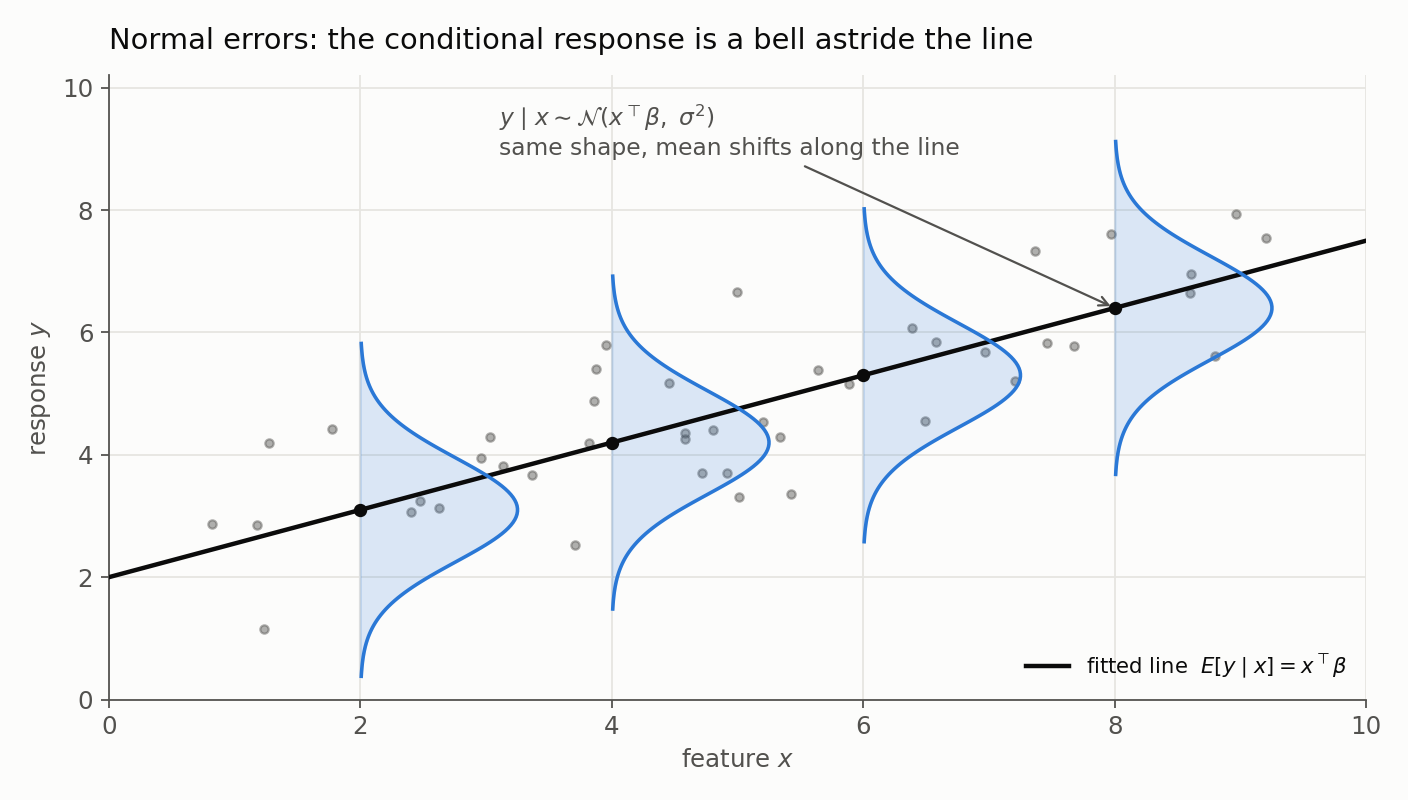
11. Why does the error term ($\epsilon$) being normally distributed ensure that the output function (y) is also from normal distribution in the linear regression?
This is due to a fundamental property of normally distributed random variables. The output variable y is a sum of a constant and a normally distributed variable, which results in another normally distributed variable.
Let’s break it down.
The Linear Regression Equation
The equation for a linear regression model is:
\[y = (\beta_0 + \beta_1X_1 + \dots + \beta_pX_p) + \epsilon\]For any given observation with specific feature values ($X_1, X_2, \dots$), we can split this equation into two parts:
The Deterministic Part: $(\beta_0 + \beta_1X_1 + \dots + \beta_pX_p)$ For a fixed set of inputs and learned coefficients, this part of the equation calculates to a single, constant value. This is the model’s prediction, often written as $\hat{y}$.
The Stochastic (Random) Part: $\epsilon$ This is the error term, which you’ve correctly stated is assumed to be a random variable drawn from a normal distribution, typically with a mean of 0 and a variance of $\sigma^2$. We write this as $\epsilon \sim N(0, \sigma^2)$.
So, we can simplify the equation to:
\[y = \text{Constant} + \text{Normal Random Variable}\]The Key Mathematical Property
A core property of normal distributions is that if you add a constant to a normally distributed random variable, the resulting new variable is also normally distributed.
Adding a constant simply shifts the mean of the distribution, it does not change its shape (the variance) or its type.
Example: If we have a random variable $\epsilon \sim N(0, \sigma^2)$, and we add a constant C to it, the new variable $y = C + \epsilon$ will follow a new normal distribution: $y \sim N(C, \sigma^2)$. The distribution is just shifted so that its center is now at C instead of 0.
Putting It Together
Since our output y is the sum of the deterministic part (a constant for a given observation) and the error term $\epsilon$ (a normal random variable), y inherits its distributional shape directly from $\epsilon$.
- The distribution of
yis Normal because it’s just a shifted version of the normal distribution of $\epsilon$. - The mean of
yis the deterministic part, $E[y] = \beta_0 + \beta_1X_1 + \dots$. - The variance of
yis the same as the variance of the error term, $Var(y) = \sigma^2$.
Therefore, the assumption that the error term is normally distributed directly ensures that the output variable y is also normally distributed around the regression line.
12. What’s the connection between Bayesian Linear Regression and L1/L2 regularization based Linear Regression?
This is one of the most elegant connections in machine learning. It bridges the gap between frequentist/optimization approaches (minimizing a loss function) and Bayesian/probabilistic approaches (updating beliefs).
The connection is this: Regularized Linear Regression is exactly equivalent to finding the Maximum A Posteriori (MAP) estimate in a Bayesian Linear Regression model with specific priors.
- Ridge Regression (L2) $\iff$ Bayesian Regression with a Gaussian Prior.
- Lasso Regression (L1) $\iff$ Bayesian Regression with a Laplace Prior.
Let’s break down the math and the intuition to see exactly how this works.
1. The Foundation: Bayes’ Theorem
In Bayesian inference, we update our beliefs about the coefficients ($\beta$) based on the data ($X, y$).
\[P(\beta \vert X, y) = \frac{P(y \vert X, \beta) \cdot P(\beta)}{P(y \vert X)}\]- Posterior: $P(\beta \vert X, y)$ : Our updated belief about the weights after seeing data.
- Likelihood $P(y \vert X, \beta)$ : How well the weights explain the data. Maximizing this is just standard OLS.
- Prior $P(\beta)$ : Our belief about the weights before seeing any data.
- Marginal Likelihood $P(y \vert X)$ : A constant normalization factor (we can ignore this for optimization).
So, finding the best weights ($\beta_{MAP}$) means maximizing:
\[\text{Posterior} \propto \text{Likelihood} \times \text{Prior}\]Or, taking the logarithm (which turns multiplication into addition):
\[\log(\text{Posterior}) \propto \log(\text{Likelihood}) + \log(\text{Prior})\]2. The Connection to L2 (Ridge Regression)
In Ridge regression, we add a penalty term $\lambda \sum \beta_j^2$. Let’s see how this emerges from the Bayesian view.
The Prior: Assume the coefficients come from a Gaussian (Normal) Distribution centered at zero. This means we believe, prior to seeing data, that the weights are likely small and close to zero.
\[P(\beta) = \frac{1}{\sqrt{2\pi\tau^2}} \exp\left( - \frac{\beta^2}{2\tau^2} \right) \Rightarrow P(\beta) \propto \exp\left(-\frac{\beta^2}{2\tau^2}\right)\]What is $\tau$ (tau)?
- $\tau$ is the Standard Deviation of the Gaussian prior.
- It represents our “uncertainty” or “tolerance” for how large the weights can be.
- Large $\tau$: The bell curve is wide and flat. We are okay with large weights. (Weak regularization).
- Small $\tau$: The bell curve is narrow and spiked. We strictly believe weights should be close to zero. (Strong regularization).
The Math: When we calculate the $\log(\text{Posterior})$:
- Log-Likelihood: Becomes the negative sum of squared errors (standard OLS part): $-\sum(y - X\beta)^2$.
- We assume the noise ($\epsilon$) in the data generation process is Gaussian.
- This means $y_i$ follows a Gaussian distribution centered at $\hat{y}_i$.
- This gives us the formula: $\text{Likelihood} \propto \exp(-(y - \hat{y})^2)$.
- This leads to the Mean Squared Error (MSE) term.
- Log-Prior: $\log(\exp(-\beta^2)) = -\beta^2$.
Therefore, maximizing the posterior is equivalent to minimizing: \(J(\beta) = \sum(y - \hat{y})^2 + \lambda \sum \beta^2\)
Conclusion: Ridge Regression is simply Bayesian Regression where you assume the weights are normally distributed. The regularization parameter $\lambda$ is inversely related to the variance of that Gaussian prior.
3. The Connection to L1 (Lasso Regression)
In Lasso regression, we add a penalty term $\lambda \sum \lvert \beta_j \rvert$.
The Prior: Assume the coefficients come from a Laplace Distribution centered at zero. The Laplace distribution looks like a double exponential. Unlike the bell curve (Gaussian), it has a very sharp peak at zero and wider tails.
\[P(\beta) = \frac{1}{2b} \exp\left( - \frac{|\beta|}{b} \right) \Rightarrow P(\beta) \propto \exp\left(-\frac{|\beta|}{b}\right)\]What is $b$?
- $b$ is the Scale Parameter of the Laplace distribution (similar concept to standard deviation).
- It controls how quickly the probability drops off as you move away from zero.
- Large $b$: The peak at zero is dull, and tails are wide. (Weak regularization).
- Small $b$: The peak at zero is extremely sharp. We strongly believe weights should be exactly zero. (Strong regularization).
The Math: When we calculate the $\log(\text{Posterior})$:
- Log-Likelihood: Still the negative sum of squared errors: $-\sum(y - X\beta)^2$.
- Same reason as L2 regularization, since the noise ($\epsilon$) in the data generation process is Gaussian.
- Log-Prior: $\log(\exp(-\lvert \beta \rvert)) = -\lvert \beta \rvert$.
Therefore, maximizing the posterior is equivalent to minimizing: \(J(\beta) = \sum(y - \hat{y})^2 + \lambda \sum |\beta|\)
Conclusion: Lasso Regression is simply Bayesian Regression where you assume the weights follow a Laplace distribution.
4. Why Intuition Matches Reality
This probabilistic view explains the behavior we see in these models:
- Gaussian Prior (Ridge): A Bell curve is flat at the top. It pulls large weights toward zero, but it doesn’t force them exactly to zero because the probability density near zero is smooth. This matches Ridge’s behavior (shrinkage, but no feature selection).
- Laplace Prior (Lasso): The Laplace distribution has a sharp spike at zero. It places a very high probability mass exactly on zero. This explains why Lasso performs feature selection, it forces coefficients to become exactly zero because that is the most probable value in the prior.
Summary Table
| Regression Type | Bayesian Equivalent | Prior Distribution | Why it works? |
|---|---|---|---|
| OLS (Vanilla) | Maximize Likelihood (MLE) | Uniform / Flat (No prior belief) | We assume all weight values are equally probable before seeing data. |
| Ridge (L2) | Maximize Posterior (MAP) | Gaussian (Normal) | We assume weights are likely small and distributed normally around zero. |
| Lasso (L1) | Maximize Posterior (MAP) | Laplace | We assume weights are likely to be exactly zero (sparsity). |
13. How do we interpret the coefficients in linear regression?
Interpreting coefficients is the bridge between a mathematical model and real-world actionable insights. However, this interpretation is fragile. It completely relies on specific conditions being met.
Here is the breakdown of how to read them and the strict rules required to trust them.
1. How to Interpret the Coefficients ($\beta$)
The interpretation depends on whether the feature (independent variable) is continuous or categorical.
Let’s use a standard housing price model equation: \(\text{Price} = \beta_0 + \beta_1(\text{SqFt}) + \beta_2(\text{HasGarage}) + \epsilon\)
A. Continuous Variables (e.g., SqFt)
If $\beta_1 = 50$:
- The Interpretation: “For every 1 unit increase in Square Footage, the Price increases by $50, holding all other variables constant.”
- Key Phrase: The phrase “holding all other variables constant” (ceteris paribus) is mandatory. It means this is the isolated effect of size, assuming the house doesn’t also gain a garage or change location.
B. Categorical/Binary Variables (e.g., HasGarage: 0 or 1)
If $\beta_2 = 15,000$:
- The Interpretation: “A house with a garage (value 1) costs $15,000 more than a house without a garage (value 0), holding all other variables constant.”
- Note: This is always a comparison against the “baseline” (where the value is 0).
C. The Intercept ($\beta_0$)
If $\beta_0 = 30,000$:
- The Interpretation: “The predicted Price when all independent variables are zero.”
- Reality Check: Often, the intercept has no physical meaning (e.g., a house with 0 SqFt cannot exist). It is primarily there to anchor the regression line.
14. If $\beta_1 \gt \beta_2$, can we say $x_1$ is a more important feature compared to $x_2$?
The short answer is NO.
You cannot determine feature importance by simply comparing the raw values of the coefficients ($\beta_1$ vs $\beta_2$).
Here is the detailed explanation of why this is a trap and how to correctly compare them.
1. The Trap: The Scale of the Features
The size of a coefficient depends entirely on the units (or scale) of the corresponding feature variable.
The Example: Imagine we are predicting the Price of a House.
- $x_1$: Size of the house in Square Feet.
- $x_2$: Distance to the nearest school in Kilometers.
Let’s look at two scenarios representing the exact same physical reality:
Scenario A:
- $x_1$ (Size): Measured in Square Feet.
- Coefficient $\beta_1 = 100$ (Price increases $100 per sq ft).
- $x_2$ (Distance): Measured in Meters.
- Coefficient $\beta_2 = -5$ (Price drops $5 per meter away).
Comparison: $\beta_1 (100) > \beta_2 (-5)$. Conclusion: You might think “Size is more important.”
Scenario B: Now, let’s just change the unit of measurement for distance.
- $x_1$ (Size): Measured in Square Feet.
- Coefficient $\beta_1 = 100$.
- $x_2$ (Distance): Measured in Kilometers (1 km = 1000 meters).
- Since 1 km is 1000x larger than 1 meter, the coefficient must be 1000x larger to have the same effect.
- Coefficient $\beta_2 = -5000$ (Price drops $5000 per km away).
Comparison: $|\beta_2| (5000) \gg \beta_1 (100)$. Conclusion: Now it looks like “Distance is vastly more important.”
The Reality: The underlying importance of the feature didn’t change, only the units did. Therefore, raw coefficients are meaningless for comparison.
2. The Solution: Standardized Coefficients
To compare $\beta_1$ and $\beta_2$ fairly, you must standardize your features (scale them) before training the model.
Standardization puts all features on the same playing field (usually Mean = 0, Standard Deviation = 1).
\[z = \frac{x - \mu}{\sigma}\]If you train a regression model on these standardized features:
- The units (feet, meters, years) disappear.
- The coefficients represents the change in Y given a 1 standard deviation increase in X.
- Result: You CAN compare these coefficients. If $\lvert \beta_{std, 1} \rvert > \lvert \beta_{std, 2} \rvert$, then $x_1$ is indeed a more influential feature than $x_2$.
3. The Other Trap: Statistical Significance
Even if you standardize your data, there is one more catch.
Imagine:
- $\beta_1 = 50$
- $\beta_2 = 5$
Can we say $x_1$ is 10x more important? Not necessarily. You must check the Standard Error and P-values.
- $x_1$ might have a huge standard error. Its 95% confidence interval might be $[-100, 200]$. This means we aren’t even sure if the effect is positive or negative! It is statistically insignificant.
- $x_2$ might have a tiny standard error. Its confidence interval might be $[4.9, 5.1]$. It is statistically significant.
In this case, despite $\beta_1$ being larger, $x_2$ is the “more important” (or at least more reliable) predictor because $x_1$ is just noise.
Summary Rule
You can only say $x_1$ is more important than $x_2$ if:
- The features have been Standardized/Scaled.
- Both coefficients are Statistically Significant (low p-values).