Probability Distribution: Negative Binomial
The Negative Binomial has two faces: a waiting time for the r-th success, and an overdispersed count arising from a Gamma mixture of Poisson rates.
- A field guide to probability distributions
- Binomial
- Geometric
- Negative Binomial You are here
- Poisson
- Exponential
- Normal
- Log-Normal
- Laplace
- Gamma
- Beta
The Question It Answers
The Negative Binomial wears two hats, and keeping them apart is the whole battle:
- A waiting time: how many trials (or failures) until the $r$-th success? This generalizes the Geometric, which stops at the first success ($r = 1$).
- An overdispersed count: how do we model counts whose variance exceeds their mean? Where the Poisson forces variance to equal the mean, the Negative Binomial adds a knob for extra spread.
They are the same distribution seen from two directions, but they are parameterized and used differently.
| Field | Content |
|---|---|
| Type | Discrete |
| Random variable | $X$ = trials until the $r$-th success (or $Y$ = failures before it) |
| Support | $X \in \{r, r+1, \dots\}$, equivalently $Y \in \{0, 1, 2, \dots\}$ |
| Parameters | $r$ = target number of successes (a count); $p$ = per-trial success probability |
| Mean | $r/p$ (trials) or $r(1-p)/p$ (failures) |
| Variance | $r(1-p)/p^2$, always larger than the failure-count mean |
| Signature | Waiting time for the $r$-th success; equivalently, a Gamma mixture of Poisson rates |
Two Conventions, Stated Cleanly
The total-trials version counts every attempt, $X \in \{r, r+1, \dots\}$:
\[P(X=k) = \binom{k-1}{r-1} p^r (1-p)^{k-r}.\]The last trial must be the $r$-th success, so $\binom{k-1}{r-1}$ arranges the other $r-1$ successes among the first $k-1$ trials. The failures-before-success version counts only failures, $Y = X - r \in \{0, 1, \dots\}$, which is what scipy.stats.nbinom uses:
Their means differ by the constant $r$, but they share a variance:
\[E[X]=\frac{r}{p},\quad E[Y]=\frac{r(1-p)}{p},\quad \text{Var}(X)=\text{Var}(Y)=\frac{r(1-p)}{p^2}.\]A Worked Example: Waiting for the 3rd Booking
Setup. A salesperson needs $r = 3$ booked meetings, and each call books with probability $p = 0.4$. Let $X$ be the call on which the 3rd booking arrives.
Probability it takes exactly 5 calls (so 2 failures land among the first 4):
\[P(X = 5) = \binom{4}{2}(0.4)^3(0.6)^2 = 6 \cdot 0.064 \cdot 0.36 \approx 0.138.\]On average it takes $E[X] = r/p = 7.5$ calls. As with the Geometric, the honest caveat is that a single $p$ across prospects is a modeling convenience, not a fact.
The Overdispersed-Count View
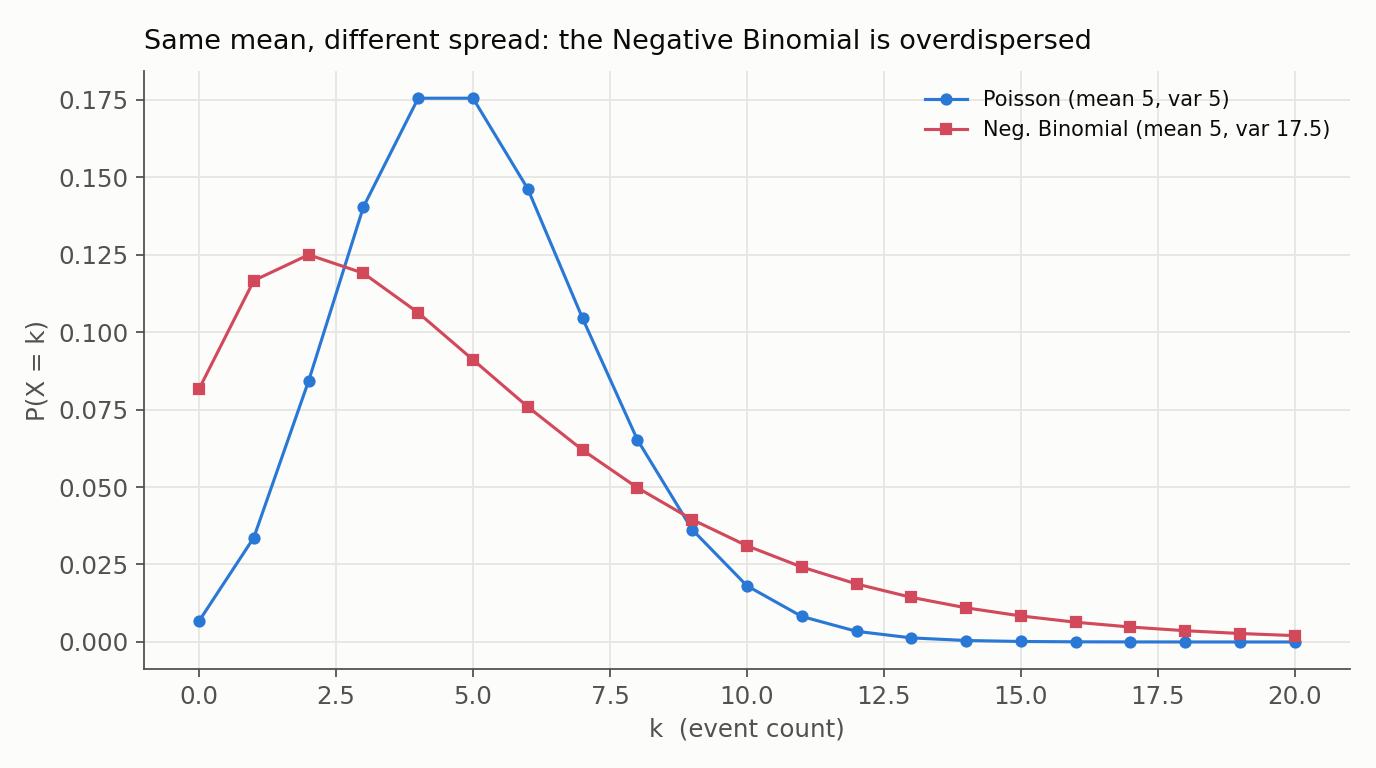
The second face is where the distribution earns its keep in practice. A Poisson count has variance equal to its mean; real count data (insects per quadrat, purchases per user, defects per batch) is often far more variable. Writing the mean as $\mu$ and a dispersion parameter $\alpha = 1/r$, the Negative Binomial gives
\[\text{Var}(Y) = \mu + \alpha \mu^2,\]which exceeds $\mu$ whenever $\alpha > 0$, and collapses back to the Poisson as $\alpha \to 0$ (that is, $r \to \infty$).
The right intuition for why is latent heterogeneity, not vague “non-independence.” Suppose each entity has its own Poisson rate, and those rates themselves vary across entities following a Gamma distribution. Mixing a Poisson over a Gamma-distributed rate produces exactly a Negative Binomial marginal count. The extra variance is the spread of the hidden rates.
One caveat: the Negative Binomial is not a universal cure for excess zeros. If a dataset has more zeros than even an overdispersed count predicts (a separate “never happens” subpopulation), that is zero inflation, and it needs a zero-inflated or hurdle model, not just a bigger dispersion.
When It Fits, and When It Fails
| Assumes | (Waiting-time) independent trials, constant $p$; (count) Poisson events with Gamma-distributed rates |
| Common violation | Excess zeros beyond overdispersion; structural clustering in time; a dispersion that itself varies with covariates |
| Closest relatives | Geometric ($r = 1$); Poisson (the $\alpha \to 0$ limit); zero-inflated models for excess zeros |
A Minimal Code Check
1
2
3
4
5
6
7
8
9
10
11
from scipy.stats import nbinom

# scipy counts FAILURES before the r-th success: nbinom(r, p)
r, p = 3, 0.4
nbinom.pmf(2, r, p)   # 2 failures = 5 total trials -> 0.138
nbinom.sf(9, r, p)    # more than 9 failures (upper tail)

# Overdispersed-count parameterization: mean mu, size r; var = mu + mu^2/r
mu, size = 5.0, 2.0
p_count = size / (size + mu)         # convert (mu, size) -> scipy's p
nbinom.stats(size, p_count, moments="mv")   # (5.0, 17.5): var > mean
Parameterization checklist: SciPy’s nbinom(n, p) uses $n = r$ successes and counts failures; the count-model form uses a mean $\mu$ and a size/dispersion $r$ (smaller $r$ means more overdispersion) with $p = r/(r+\mu)$. R and statsmodels often report dispersion as $\alpha = 1/r$. Confirm which before trusting a fitted parameter.
Appendix: Deriving the Mean and Variance
In the waiting-time view, reaching the $r$-th success means completing $r$ independent Geometric waits, one per success: $X = X_1 + \dots + X_r$, where each $X_i$ counts the trials for one more success and is Geometric($p$). Both moments then reduce to the Geometric’s, whose derivations are in the Geometric appendix.
The Mean
Each wait has $E[X_i] = 1/p$. Expectation is linear, so
\[E[X] = \sum_{i=1}^{r} E[X_i] = r\cdot\frac{1}{p} = \frac{r}{p}.\]The Variance
The $r$ waits are independent, so their variances add. Each has $\text{Var}(X_i) = (1-p)/p^2$, giving
\[\text{Var}(X) = \sum_{i=1}^{r}\text{Var}(X_i) = r\cdot\frac{1-p}{p^2} = \frac{r(1-p)}{p^2}.\]At $r = 1$ these collapse to the Geometric’s moments, as they must.
As for the name: the “negative” has nothing to do with negative counts. The PMF terms are exactly the coefficients of the negative-binomial series expansion of $(1-q)^{-r}$, which is where the distribution takes its name.
Where this sits in the series. Previous concept: Geometric (the first success). Next concept: Poisson (event counts in continuous time). Closest cousin: Poisson again, as the no-overdispersion limit. Series overview.