Probability Distribution: Geometric
The Geometric distribution counts trials until the first success: memoryless waiting, a planning quantile, and how it bridges to Exponential and Negative Binomial.
- A field guide to probability distributions
- Binomial
- Geometric You are here
- Negative Binomial
- Poisson
- Exponential
- Normal
- Log-Normal
- Laplace
- Gamma
- Beta
The Question It Answers
How many independent attempts do we make until the first success? Each attempt succeeds with the same probability $p$; the Geometric random variable $X$ is the trial on which the first success lands. It is the natural partner of the Binomial: same trials, but instead of fixing the number of attempts and counting successes, we fix “one success” and count attempts.
| Field | Content |
|---|---|
| Type | Discrete |
| Random variable | $X$ = trial number of the first success |
| Support | $X \in \{1, 2, 3, \dots\}$ (the “failures-before-success” convention starts at 0 instead) |
| Parameters | $p$ = success probability per trial (dimensionless, $0 < p \le 1$) |
| Mean | $1/p$ (a 1-in-10 event takes 10 attempts on average) |
| Variance | $(1-p)/p^2$ |
| Signature | The only memoryless discrete distribution: past failures never change what comes next |
Two conventions. The version above counts trials ($k = 1, 2, \dots$). A second common version counts failures before the first success ($k = 0, 1, \dots$), with PMF $(1-p)^k p$. Always check which one a library uses: scipy.stats.geom counts trials starting at 1.
Shape Before Formula
The PMF decays geometrically: each extra trial multiplies the probability by $(1-p)$, so the mass is highest at $k=1$ and falls off at a constant rate. A larger $p$ decays faster (success comes quickly); a smaller $p$ stretches the wait.
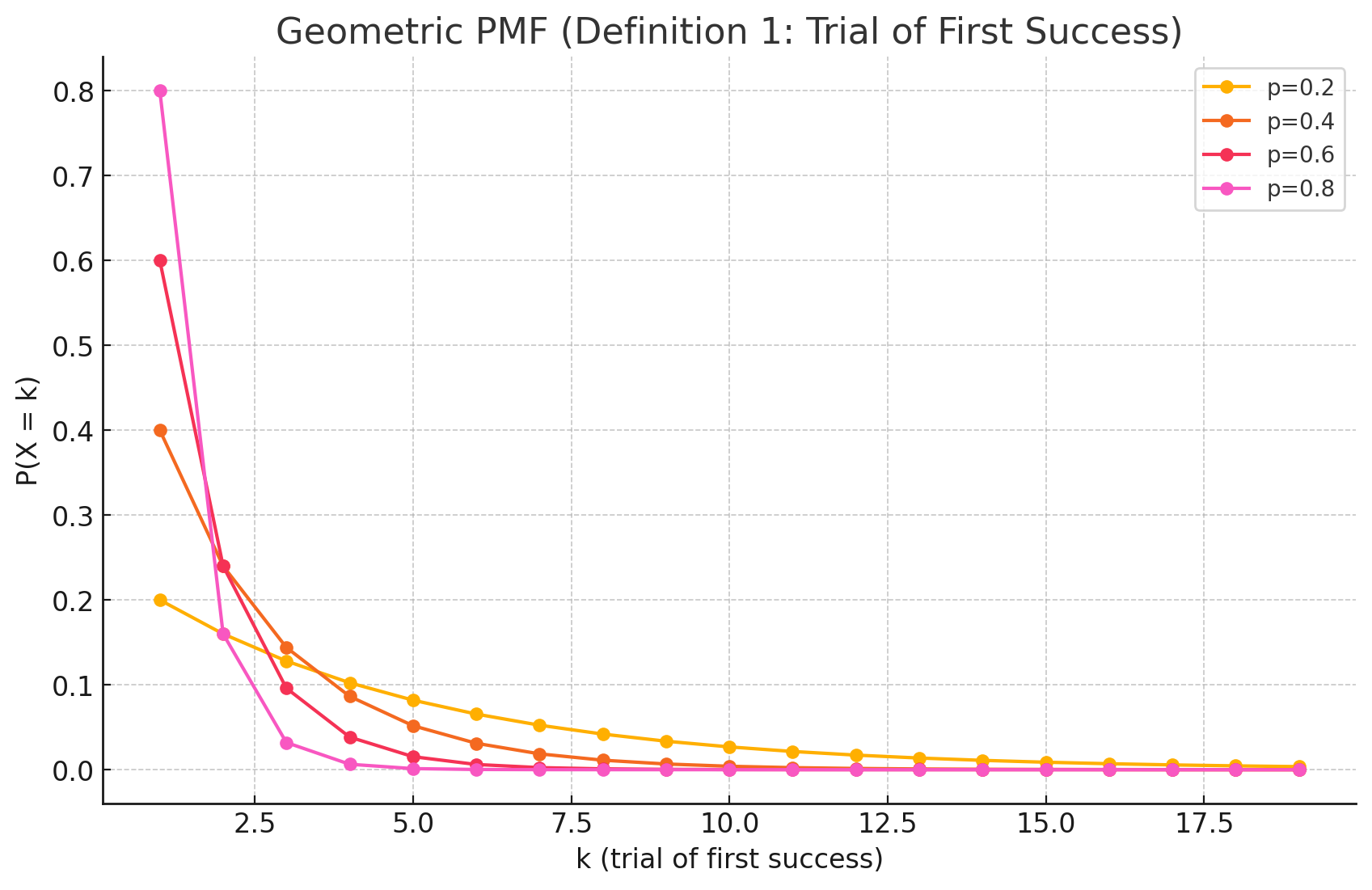
The reasoning is direct: to get the first success exactly on trial $k$, we need $k-1$ failures (probability $(1-p)^{k-1}$) followed by one success (probability $p$), and independence lets us multiply.
A Worked Example: Cold-Call Prospecting
Setup. A salesperson books a meeting on about 10% of cold calls ($p = 0.10$). Let $X$ be the call on which the first booking happens.
Check the assumptions. Each call is a yes/no trial; treating them as independent with a constant $p$ is only reasonable if prospects are similar and unordered. In reality $p$ varies (a warm lead is not a random dial), which widens the true spread, so read the numbers as a planning model, not a promise.
Exactly the 5th call: $P(X=5) = (0.9)^4 (0.1) \approx 0.066$.
The more useful questions use the tail and the quantile:
- Survival, “still no booking after 5 calls”: $P(X > 5) = (0.9)^5 \approx 0.590$.
- Planning quantile, “how many calls give at least a 95% chance of one booking?” We need $P(X \le k) = 1 - (0.9)^k \ge 0.95$, i.e. $(0.9)^k \le 0.05$, which gives $k \ge 29$. So 29 calls buy a 95% chance of at least one meeting, far more informative than the probability of success on any single chosen call.
Beyond “Exactly”: CDF and Survival
The two companion functions have clean closed forms (trials convention):
\[F(k) = P(X \le k) = 1 - (1-p)^k, \qquad S(k) = P(X > k) = (1-p)^k.\]“At least one success within $k$ tries” is just $F(k)$, and the quantile above inverts it.
Memorylessness
The Geometric distribution is memoryless: given that the first $m$ trials all failed, the probability of waiting $n$ more is unchanged,
\[P(X > m+n \mid X > m) = P(X > n).\]A coin that has come up tails ten times in a row is no more “due” for heads. This is exactly the discrete echo of the Exponential distribution’s memorylessness in continuous time, and it is a strong modeling assumption: any process with fatigue, learning, or aging violates it.
When It Fits, and When It Fails
| Assumes | Independent trials, each with the same success probability $p$ |
| Common violation | $p$ differs across prospects or units; sampling without replacement from a finite batch breaks independence |
| Closest relatives | Negative Binomial (wait for the $r$-th success, not just the first); Exponential (the continuous-time analogue) |
A Minimal Code Check
1
2
3
4
5
6
7
from scipy.stats import geom

p = 0.10
geom.pmf(5, p)     # first success exactly on call 5 -> 0.066
geom.sf(5, p)      # still no success after 5 calls   -> 0.590
geom.ppf(0.95, p)  # calls for a 95% chance of one    -> 29
geom.stats(p, moments="mv")   # (mean, var) = (10.0, 90.0)
Appendix: Deriving the Mean and Variance
Write $q = 1 - p$, with support $k = 1, 2, \dots$ and $P(X = k) = q^{k-1}p$. Both moments come from differentiating the geometric series $\sum_{k\ge 0} q^k = 1/(1-q)$.
The Mean
\[E[X] = \sum_{k=1}^{\infty} k\,q^{k-1}p = p\sum_{k=1}^{\infty} k\,q^{k-1}.\]Differentiating $\sum_{k\ge 0} q^k = 1/(1-q)$ term by term gives $\sum_{k\ge 1} k\,q^{k-1} = 1/(1-q)^2$. Since $1 - q = p$,
\[E[X] = p\cdot\frac{1}{(1-q)^2} = p\cdot\frac{1}{p^2} = \frac{1}{p}.\]The interpretation is the memorable part: a 1-in-$p$ event takes $1/p$ attempts on average.
The Variance
We take the second factorial moment. Differentiating the series once more,
\[\sum_{k=2}^{\infty} k(k-1)\,q^{k-2} = \frac{2}{(1-q)^3},\]and multiplying by $q$ to match the exponent in the PMF:
\[E[X(X-1)] = p\sum_{k=2}^{\infty} k(k-1)\,q^{k-1} = p\cdot\frac{2q}{(1-q)^3} = \frac{2q}{p^2}.\]Then $E[X^2] = E[X(X-1)] + E[X] = 2q/p^2 + 1/p = (2q + p)/p^2$, so
\[\text{Var}(X) = \frac{2q + p}{p^2} - \frac{1}{p^2} = \frac{2q + p - 1}{p^2} = \frac{q}{p^2} = \frac{1-p}{p^2},\]using $p + q = 1$, so that $p - 1 = -q$.
Where this sits in the series. Previous concept: Binomial (successes in a fixed number of trials). Next concept: Negative Binomial (trials until the $r$-th success). Closest cousin: Exponential (continuous waiting time). Series overview.