Probability Distribution: Poisson
The Poisson distribution counts constant-rate events in an interval: separating rate from expected count, the mean-equals-variance diagnostic, and the bridge to Exponential.
- A field guide to probability distributions
- Binomial
- Geometric
- Negative Binomial
- Poisson You are here
- Exponential
- Normal
- Log-Normal
- Laplace
- Gamma
- Beta
The Question It Answers
How many events occur in a fixed interval of time or space? Calls to a support line in an hour, mutations along a strand of DNA, meteors in a night: if events happen independently at a steady average rate, the Poisson distribution gives the count.
The single most important habit is to separate the rate from the expected count. If events occur at rate $\lambda$ per unit time, then over an interval of length $t$ the count is
\[N(t) \sim \operatorname{Poisson}(\lambda t),\]so the parameter that goes into the PMF is the mean count $\lambda t$, not the rate $\lambda$ alone. Using one symbol for both is the source of most Poisson confusion.
| Field | Content |
|---|---|
| Type | Discrete |
| Random variable | $N$ = number of events in an interval of length $t$ |
| Support | $N \in \{0, 1, 2, \dots\}$ |
| Parameters | $\lambda$ = event rate (events per unit time/space); interval length $t$; expected count $\lambda t$ |
| Mean | $\lambda t$ |
| Variance | $\lambda t$ (equal to the mean) |
| Signature | Independent events at a constant rate; mean equals variance |
Shape Before Formula
As the expected count $\lambda t$ grows, the mass shifts right and spreads out, and the shape drifts from a sharp right-skewed spike near zero toward a roughly symmetric bump.
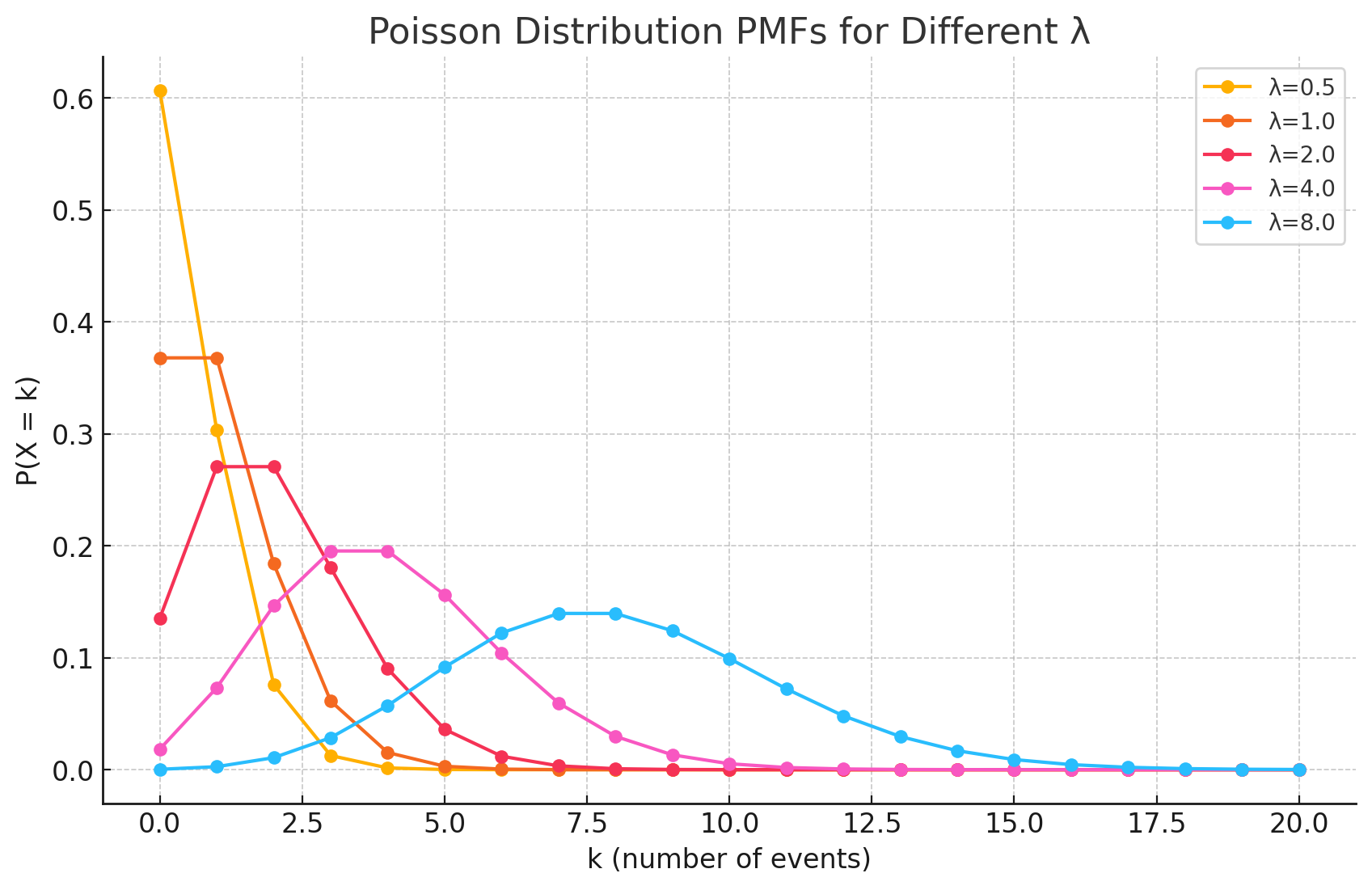
A useful scaling law follows immediately: doubling the interval doubles the expected count, because $N(2t) \sim \operatorname{Poisson}(2\lambda t)$.
A Worked Example: Call-Center Traffic
Setup. A support line receives calls at a rate of $\lambda = 5$ per hour. Over one hour, the count is $N \sim \operatorname{Poisson}(5)$.
- Exactly two calls: $P(N=2) = \frac{5^2 e^{-5}}{2!} \approx 0.084$.
- At most two (a quiet hour): $P(N \le 2) \approx 0.125$.
- More than eight (a surge, an upper-tail question): $P(N > 8) \approx 0.068$.
- Over two hours the expectation is $\lambda t = 10$, and $P(N = 10) \approx 0.125$.
For contrast, an incident tracker that logs about 3 outage incidents per day has a $P(N=0) = e^{-3} \approx 0.05$ chance of a clean day. (We say “incidents,” not “bugs”: a latent software defect is not a constant-rate recurring event, so it is a poor fit for a Poisson story.)
Mean Equals Variance: A Diagnostic, Not a Law
For a true Poisson process, $\text{Var}(N) = \lambda t = E[N]$. That equality is a diagnostic to test, not a property to assume. Real count data often violates it:
- Overdispersion (variance $>$ mean): clustering or latent heterogeneity, the case the Negative Binomial is built for.
- Underdispersion (variance $<$ mean): more regular than random, as with scheduled events.
- Seasonality or trends: the rate is not actually constant.
If the sample variance is far from the mean, the Poisson assumptions are suspect. Those assumptions, precisely, are: independent counts in disjoint intervals, a constant rate, and a negligible chance of two events in an infinitesimally small window.
The Bridge to Exponential (and a Word on Maintenance)
Counts and waiting times are two views of the same process. The chance of zero events in a window of length $t$ is $e^{-\lambda t}$, which is exactly the probability that the waiting time $T$ to the next event exceeds $t$:
\[P(T > t) = P(N(t) = 0) = e^{-\lambda t}.\]That is the Exponential survival function, so Poisson counts and Exponential interarrival times are inseparable.
This link is often used to estimate a mean time between failures (MTBF). If a repairable sorting machine logs 12 failures over 3 years, the rate is $\lambda = 4$ per year and the MTBF is $1/\lambda = 3$ months. But two cautions matter. First, this is MTBF for a repairable machine under a constant-rate model, not the mean time to failure of a population of one-shot components. Second, and more subtly, a constant-rate (memoryless) process gives no benefit from age-based preventive maintenance: if the failure hazard truly does not rise with age, replacing a part early does not lower the failure rate. Justifying “service every 2.5 months” requires evidence of an increasing hazard (wear or aging), which the Poisson model explicitly denies.
A Minimal Code Check
1
2
3
4
5
6
7
from scipy.stats import poisson

mu = 5.0               # expected count = lambda * t over one hour
poisson.pmf(2, mu)     # exactly 2      -> 0.084
poisson.cdf(2, mu)     # at most 2      -> 0.125
poisson.sf(8, mu)      # more than 8    -> 0.068
poisson.pmf(10, 2*mu)  # 10 over 2 hrs  -> 0.125 (scaling law)
Appendix: Deriving the Mean and Variance
Write $m = \lambda t$ for the expected count over the interval, so the PMF is $P(N = k) = m^k e^{-m}/k!$. Both moments fall out of the Taylor series $e^{m} = \sum_{n\ge 0} m^n/n!$.
The Mean
\[E[N] = \sum_{k=0}^{\infty} k\,\frac{m^k e^{-m}}{k!}.\]The $k = 0$ term is zero, and $k/k! = 1/(k-1)!$, so the sum starts at $k = 1$:
\[E[N] = e^{-m}\sum_{k=1}^{\infty}\frac{m^k}{(k-1)!}.\]Factor out one $m$ and re-index with $n = k - 1$, which turns the remaining sum back into the Taylor series for $e^{m}$:
\[E[N] = e^{-m}\, m \sum_{n=0}^{\infty}\frac{m^{n}}{n!} = e^{-m}\, m\, e^{m} = m.\]The Variance
The trick is to find the second factorial moment $E[N(N-1)]$ first, because the $k(k-1)$ factor cleanly clears the two leading terms of the factorial:
\[E[N(N-1)] = \sum_{k=0}^{\infty} k(k-1)\,\frac{m^k e^{-m}}{k!} = e^{-m}\sum_{k=2}^{\infty}\frac{m^k}{(k-2)!}.\]Factoring out $m^2$ and re-indexing with $n = k - 2$ gives $e^{-m}\, m^2\, e^{m} = m^2$. Since $E[N(N-1)] = E[N^2] - E[N]$, we have $E[N^2] = m^2 + m$, and therefore
\[\text{Var}(N) = E[N^2] - (E[N])^2 = (m^2 + m) - m^2 = m.\]Both moments equal $m = \lambda t$: the signature that, for a Poisson, mean and variance coincide. Compared with the Binomial, the difference is what is fixed: the Binomial fixes a number of opportunities $n$, while the Poisson fixes an interval and lets the count run over effectively unlimited opportunities.
Where this sits in the series. Previous concept: Negative Binomial. Next concept: Exponential (waiting time for the next event). Closest cousins: Exponential (the waiting-time dual) and Binomial (its fixed-opportunity counterpart). Series overview.